Silicate Minerals · common
Microcline
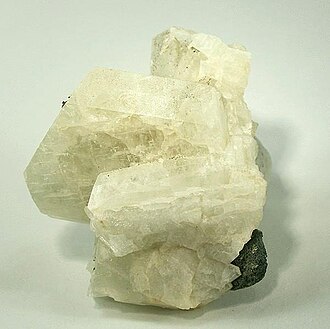
Microcline is a potassium-rich feldspar and a rock-forming mineral in granites and pegmatites. Its blue-green gem variety, amazonite, is widely collected, while ordinary microcline appears as cream, pink, or gray crystals and masses.
Also known as: Potassium feldspar, Amazonstone.
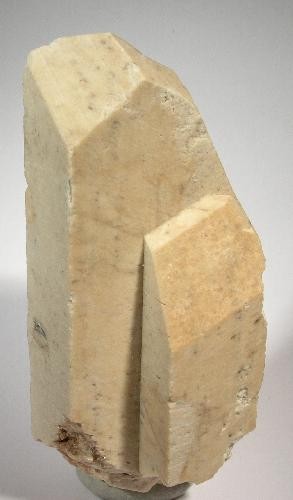
Microcline properties at a glance
| Type | Silicate Minerals |
|---|---|
| Chemical formula | KAlSi3O8 |
| Mohs hardness | 6 |
| Crystal system | triclinic |
| Luster | vitreous |
| Streak | White |
| Cleavage | Perfect on {001}, good on {010} |
| Fracture | Uneven |
| Specific gravity | 2.56 |
| Transparency | translucent |
| Common colors | White, Cream, Pink, Green, Gray |
| Rarity | common |
Geology & background
Microcline is a potassium feldspar that crystallizes in granitic rocks and pegmatites, and is the form of potassium feldspar that becomes stable at lower temperatures.
Microcline has been used for centuries in ceramics and glassmaking, and its amazonite variety was worked into beads and ornaments by ancient cultures in Egypt and elsewhere.
How to identify Microcline
- Look for two cleavage directions meeting at nearly right angles and a hardness of about 6.
- Blue-green color suggests the amazonite variety, but confirm with cleavage and crystal habit.
- Microcline is difficult to tell from orthoclase by eye; a microscope reveals its tartan twinning.
Full Microcline identification guide: checklist, home tests and look-alikes →
Microcline vs similar stones
Not sure it isn't something else? Side-by-side comparisons with the stones most often confused with Microcline.
Where Microcline is found
Microcline occurs in granites and pegmatites worldwide, with notable specimen and amazonite localities in the United States, Brazil, Russia, Madagascar, Canada, and Norway.
How much is Microcline worth?
| Entry-level specimen | $5 |
|---|---|
| Typical collector specimen | $40 |
| Premium specimen | $300+ |
Value depends on color, crystal form, locality, transparency, and aesthetics, with amazonite commanding more.
Common uses
- Ceramics and porcelain
- Glass manufacturing
- Amazonite gemstones
- Collector specimens
- Mild abrasives and fillers
Interesting facts
- The vivid blue-green variety amazonite is one of the best-known feldspar gemstones.
- Microcline often shows a fine cross-hatched 'tartan' twinning pattern under a microscope.
- It is chemically identical to orthoclase and sanidine but differs in crystal structure and ordering.
- Some pegmatites contain microcline crystals weighing many tons.
Care & safety
Microcline is reasonably hard but brittle and can split along its perfect cleavage planes.
Avoid inhaling dust. Do not cut, grind, or polish unknown specimens without eye protection and a proper respirator.
Microcline FAQ
What is Microcline?
Microcline is a potassium-rich feldspar and a rock-forming mineral in granites and pegmatites. Its blue-green gem variety, amazonite, is widely collected, while ordinary microcline appears as cream, pink, or gray crystals and masses.
How much is Microcline worth?
Entry-level Microcline specimens sell for around $5, a typical collector specimen for about $40, and premium pieces for $300 or more. Value depends on color, crystal form, locality, transparency, and aesthetics, with amazonite commanding more.
How hard is Microcline?
Microcline has a Mohs hardness of 6. It is about as hard as window glass: a knife barely marks it, while a steel file (Mohs 6.5) will.
Where is Microcline found?
Notable sources of Microcline include United States, Brazil, Russia, Madagascar, Canada, and Norway. Microcline is a potassium feldspar that crystallizes in granitic rocks and pegmatites, and is the form of potassium feldspar that becomes stable at lower temperatures..
What is Microcline used for?
Microcline is used for ceramics and porcelain, glass manufacturing, amazonite gemstones, collector specimens, and mild abrasives and fillers.