Silicate Minerals · common
Orthoclase
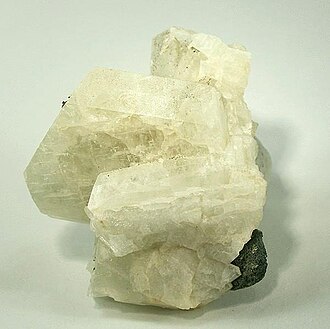
Orthoclase is a common potassium feldspar and a major rock-forming mineral in granitic rocks. It defines hardness 6 on the Mohs scale and appears as cream, pink, or colorless crystals and masses.
Also known as: Potassium feldspar, Potash feldspar, Orthoclase feldspar.
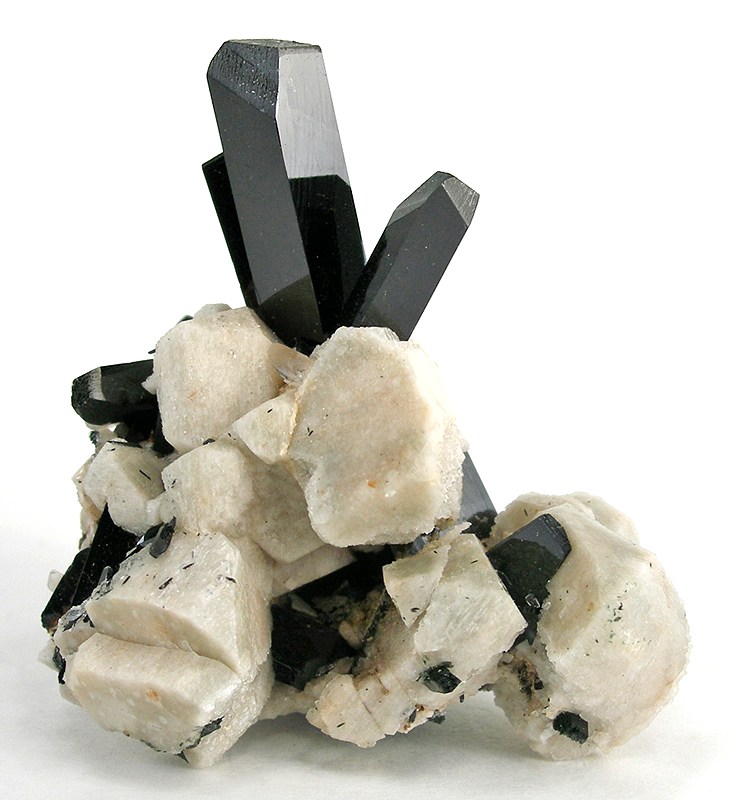
Orthoclase properties at a glance
| Type | Silicate Minerals |
|---|---|
| Chemical formula | KAlSi3O8 |
| Mohs hardness | 6 |
| Crystal system | monoclinic |
| Luster | vitreous |
| Streak | White |
| Cleavage | Perfect on {001}, good on {010} |
| Fracture | Uneven to conchoidal |
| Specific gravity | 2.56 |
| Transparency | translucent |
| Common colors | Colorless, White, Cream, Pink, Yellow |
| Rarity | common |
Geology & background
Orthoclase is a potassium feldspar that crystallizes from cooling magma in granites, syenites, and pegmatites, and also occurs in some metamorphic rocks formed at moderate temperatures.
Orthoclase has been used for centuries in ceramics, glass, and glaze production, and as a familiar rock-forming feldspar it became a reference point in mineral hardness and petrology.
How to identify Orthoclase
- Look for blocky cream, pink, or colorless crystals with two cleavage directions at right angles.
- Orthoclase has a hardness of 6 and a vitreous luster, often with a pearly sheen on cleavage faces.
- It is hard to separate from microcline by eye; twinning and optical tests confirm the species.
Full Orthoclase identification guide: checklist, home tests and look-alikes →
Orthoclase vs similar stones
Not sure it isn't something else? Side-by-side comparisons with the stones most often confused with Orthoclase.
Where Orthoclase is found
Orthoclase occurs in granitic and metamorphic rocks worldwide, with notable specimen and gem localities in Madagascar, Germany, Italy, the United States, Sri Lanka, and Myanmar.
How much is Orthoclase worth?
| Entry-level specimen | $5 |
|---|---|
| Typical collector specimen | $35 |
| Premium specimen | $250+ |
Value depends on crystal form, color, transparency, twinning, locality, and aesthetic quality of the specimen.
Common uses
- Ceramics and porcelain
- Glass manufacturing
- Glazes and enamels
- Gem orthoclase
- Collector specimens
Interesting facts
- Orthoclase is the index mineral for hardness 6 on the Mohs scale.
- Its name means 'straight fracture,' referring to its two cleavage planes meeting at right angles.
- Transparent yellow orthoclase from Madagascar is faceted as a collector gemstone.
- The moonstone effect can appear in feldspar where orthoclase and albite are finely intergrown.
Care & safety
Orthoclase is fairly hard but brittle and can split cleanly along its perfect cleavage.
Avoid inhaling dust. Do not cut, grind, or polish unknown specimens without eye protection and a proper respirator.
Orthoclase FAQ
What is Orthoclase?
Orthoclase is a common potassium feldspar and a major rock-forming mineral in granitic rocks. It defines hardness 6 on the Mohs scale and appears as cream, pink, or colorless crystals and masses.
How much is Orthoclase worth?
Entry-level Orthoclase specimens sell for around $5, a typical collector specimen for about $35, and premium pieces for $250 or more. Value depends on crystal form, color, transparency, twinning, locality, and aesthetic quality of the specimen.
How hard is Orthoclase?
Orthoclase has a Mohs hardness of 6. It is about as hard as window glass: a knife barely marks it, while a steel file (Mohs 6.5) will.
Where is Orthoclase found?
Notable sources of Orthoclase include Madagascar, Germany, Italy, United States, Sri Lanka, and Myanmar. Orthoclase is a potassium feldspar that crystallizes from cooling magma in granites, syenites, and pegmatites, and also occurs in some metamorphic rocks formed at moderate temperatures..
What is Orthoclase used for?
Orthoclase is used for ceramics and porcelain, glass manufacturing, glazes and enamels, gem orthoclase, and collector specimens.