Silicate Minerals · common
Phlogopite
Phlogopite is a magnesium-rich member of the mica group, recognized by its brown to tan color and perfect basal cleavage that splits into thin, flexible, elastic sheets. It typically forms tabular or pseudohexagonal crystals in marbles and magnesium-rich rocks.
Also known as: Magnesium mica, Brown mica.
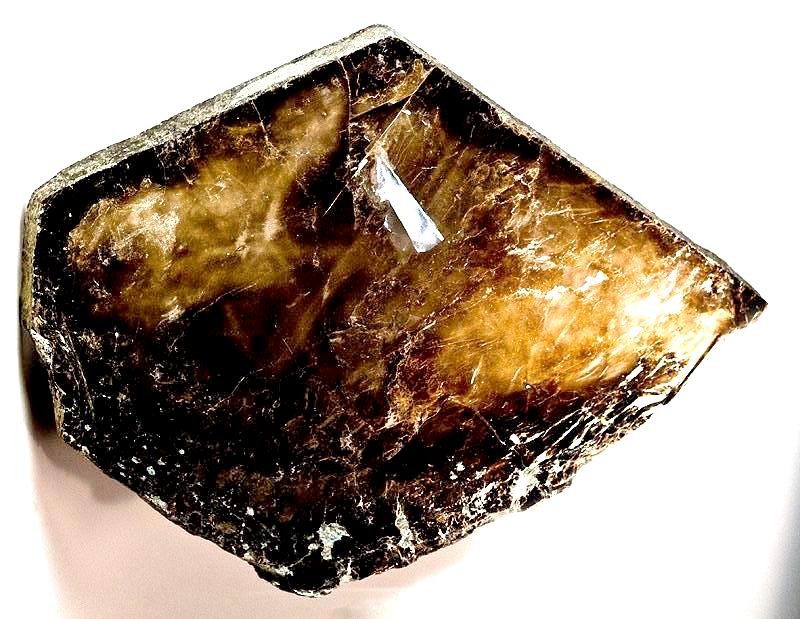
Phlogopite properties at a glance
| Type | Silicate Minerals |
|---|---|
| Chemical formula | KMg3(AlSi3O10)(OH)2 |
| Mohs hardness | 2.75 |
| Crystal system | monoclinic |
| Luster | pearly |
| Streak | White |
| Cleavage | Perfect basal |
| Fracture | Uneven |
| Specific gravity | 2.8 |
| Transparency | translucent |
| Common colors | Brown, Yellow, Tan, Reddish brown, Green |
| Rarity | common |
Geology & background
Phlogopite forms in magnesium-rich metamorphic rocks such as marble and skarn, and in ultramafic and alkaline igneous rocks, where potassium and magnesium combine in mica-forming conditions.
Phlogopite and related sheet micas were historically mined for electrical and thermal insulation, lamp chimneys, and stove windows, valued because thin sheets are transparent, flexible, and resistant to heat.
How to identify Phlogopite
- Look for brown to tan color and a perfect basal cleavage that peels into thin, flexible, elastic sheets.
- Single cleavage flakes are nearly transparent and bounce back after gentle bending.
- Phlogopite is soft and commonly occurs in marble or magnesium-rich rock, often with calcite and diopside.
Full Phlogopite identification guide: checklist, home tests and look-alikes →
Phlogopite vs similar stones
Not sure it isn't something else? Side-by-side comparisons with the stones most often confused with Phlogopite.
Where Phlogopite is found
Phlogopite occurs in marbles, skarns, and magnesium-rich igneous rocks worldwide, with notable specimen localities in Canada, Russia, Madagascar, Sri Lanka, the United States, and Italy.
How much is Phlogopite worth?
| Entry-level specimen | $5 |
|---|---|
| Typical collector specimen | $40 |
| Premium specimen | $250+ |
Value depends on crystal size, color, clarity of cleavage sheets, locality, matrix, and overall condition.
Common uses
- Electrical insulation
- Thermal insulation
- Filler in paints and plastics
- Industrial mineral applications
- Collector specimens
Interesting facts
- Phlogopite cleaves into thin sheets so flexible and elastic that they spring back after bending.
- Its name comes from a Greek word for fire-like, a reference to the reddish tints seen in some crystals.
- Like other micas, it can be heat-resistant and electrically insulating, which gave sheet mica industrial value.
- Phlogopite grades chemically into biotite as iron replaces magnesium in its structure.
Care & safety
Phlogopite is soft and its thin cleavage sheets bend and split easily, so crystals are fragile.
Avoid inhaling dust. Do not cut, grind, or polish unknown specimens without eye protection and a proper respirator.
Phlogopite FAQ
What is Phlogopite?
Phlogopite is a magnesium-rich member of the mica group, recognized by its brown to tan color and perfect basal cleavage that splits into thin, flexible, elastic sheets. It typically forms tabular or pseudohexagonal crystals in marbles and magnesium-rich rocks.
How much is Phlogopite worth?
Entry-level Phlogopite specimens sell for around $5, a typical collector specimen for about $40, and premium pieces for $250 or more. Value depends on crystal size, color, clarity of cleavage sheets, locality, matrix, and overall condition.
How hard is Phlogopite?
Phlogopite has a Mohs hardness of 2.75. A copper coin (Mohs 3.5) scratches it, but a fingernail does not.
Where is Phlogopite found?
Notable sources of Phlogopite include Canada, Russia, Madagascar, Sri Lanka, United States, and Italy. Phlogopite forms in magnesium-rich metamorphic rocks such as marble and skarn, and in ultramafic and alkaline igneous rocks, where potassium and magnesium combine in mica-forming conditions..
What is Phlogopite used for?
Phlogopite is used for electrical insulation, thermal insulation, filler in paints and plastics, industrial mineral applications, and collector specimens.