Silicate Minerals · uncommon
Prehnite
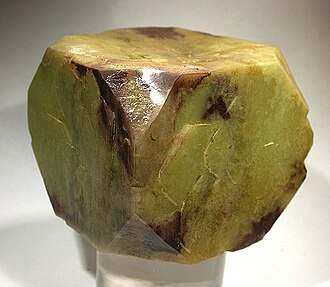
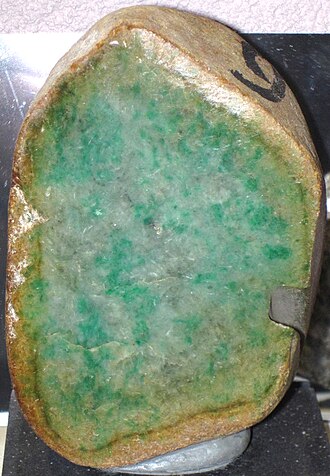
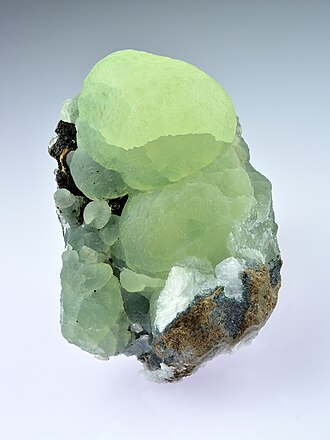
Prehnite is a calcium aluminum silicate best known for its soft green to yellow-green color and rounded, botryoidal crystal aggregates. It commonly lines cavities in basalt and is valued by collectors and lapidaries for its translucent glow.
Also known as: Cape emerald.
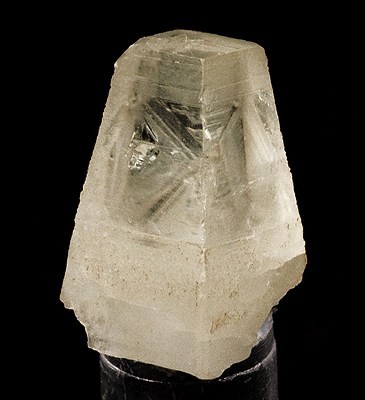
Prehnite properties at a glance
| Type | Silicate Minerals |
|---|---|
| Chemical formula | Ca2Al2Si3O10(OH)2 |
| Mohs hardness | 6.25 |
| Crystal system | orthorhombic |
| Luster | vitreous |
| Streak | White |
| Cleavage | Good |
| Fracture | Uneven |
| Specific gravity | 2.88 |
| Transparency | translucent |
| Common colors | Green, Yellow-green, Yellow, White, Gray |
| Rarity | uncommon |
Geology & background
Prehnite forms as a secondary mineral lining cavities and fractures in volcanic rocks, and also in metamorphosed rocks, where calcium-rich fluids crystallize at low temperatures.
Prehnite was described in the late eighteenth century from material collected at the Cape of Good Hope and is often cited as the first mineral named after the person who discovered it.
How to identify Prehnite
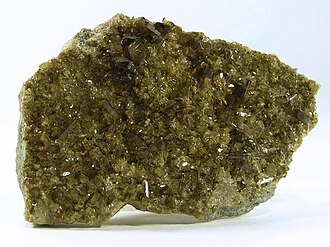
- Look for soft green to yellow-green color and rounded, botryoidal aggregates lining rock cavities.
- Prehnite is moderately hard, translucent, and has a glassy luster on crystal surfaces.
- It commonly occurs in basalt with zeolites, calcite, and epidote, which helps confirm identification.
Full Prehnite identification guide: checklist, home tests and look-alikes →
Prehnite photos
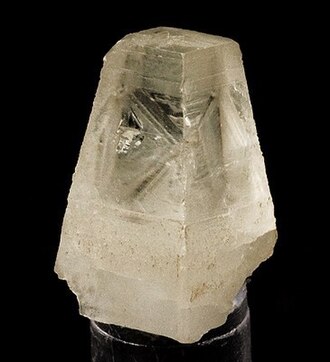
Prehnite vs similar stones
Not sure it isn't something else? Side-by-side comparisons with the stones most often confused with Prehnite.
Where Prehnite is found
Prehnite occurs in volcanic cavities and metamorphic rocks worldwide, with notable specimen localities in South Africa, Australia, China, the United States, Scotland, and France.
How much is Prehnite worth?
| Entry-level specimen | $10 |
|---|---|
| Typical collector specimen | $70 |
| Premium specimen | $400+ |
Value depends on color, translucency, crystal form, size, locality, matrix, and overall condition.
Common uses
- Cabochons and gemstones
- Jewelry
- Lapidary carving
- Ornamental objects
- Collector specimens
Interesting facts
- Prehnite was one of the first minerals to be named after a person, the Dutch officer Hendrik von Prehn.
- It often grows as rounded, grape-like botryoidal masses built from tightly packed crystals.
- Translucent green prehnite can show a soft internal glow that lapidaries cut into cabochons.
- Needles of epidote or other minerals are sometimes trapped inside prehnite, creating striking specimens.
Care & safety
Prehnite is moderately hard and fairly tough, but sharp impacts can chip botryoidal surfaces.
Avoid inhaling dust. Do not cut, grind, or polish unknown specimens without eye protection and a proper respirator.
Prehnite FAQ
What is Prehnite?
Prehnite is a calcium aluminum silicate best known for its soft green to yellow-green color and rounded, botryoidal crystal aggregates. It commonly lines cavities in basalt and is valued by collectors and lapidaries for its translucent glow.
How much is Prehnite worth?
Entry-level Prehnite specimens sell for around $10, a typical collector specimen for about $70, and premium pieces for $400 or more. Value depends on color, translucency, crystal form, size, locality, matrix, and overall condition.
How hard is Prehnite?
Prehnite has a Mohs hardness of 6.25. It is about as hard as window glass: a knife barely marks it, while a steel file (Mohs 6.5) will.
Where is Prehnite found?
Notable sources of Prehnite include South Africa, Australia, China, United States, Scotland, and France. Prehnite forms as a secondary mineral lining cavities and fractures in volcanic rocks, and also in metamorphosed rocks, where calcium-rich fluids crystallize at low temperatures..
What is Prehnite used for?
Prehnite is used for cabochons and gemstones, jewelry, lapidary carving, ornamental objects, and collector specimens.