Silicate Minerals · uncommon
Staurolite
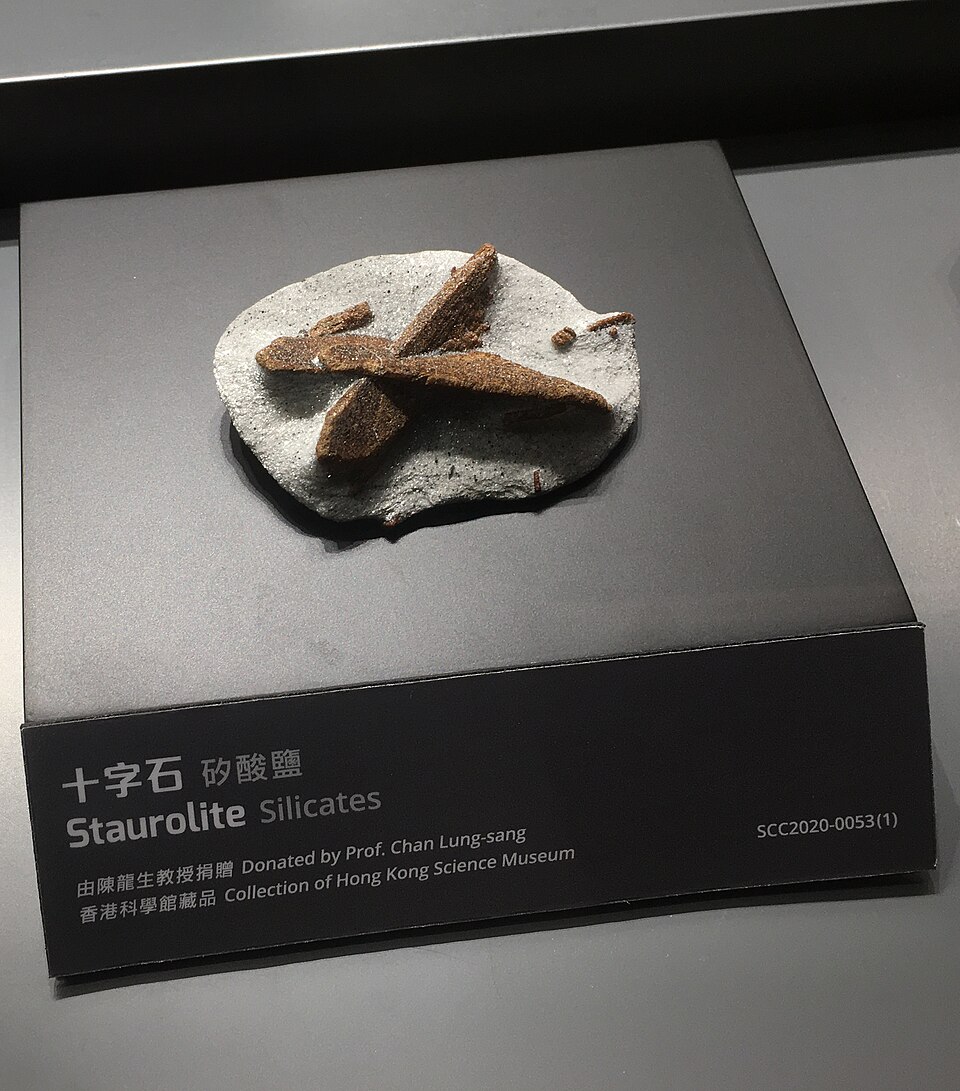
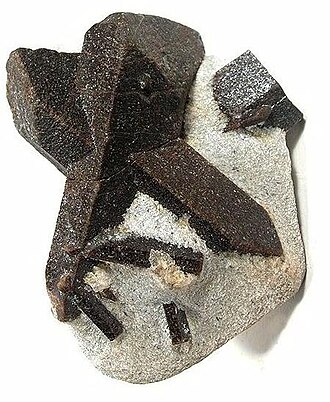
Staurolite is an iron aluminum silicate famous for its cross-shaped twinned crystals. It forms reddish-brown to nearly black prismatic crystals in metamorphic schists and is a classic index mineral of medium-grade metamorphism.
Also known as: Fairy cross, Fairy stone, Cross stone.
Staurolite properties at a glance
| Type | Silicate Minerals |
|---|---|
| Chemical formula | Fe2Al9Si4O23(OH) |
| Mohs hardness | 7.25 |
| Crystal system | monoclinic |
| Luster | vitreous |
| Streak | White to grayish |
| Cleavage | Distinct in one direction |
| Fracture | Subconchoidal |
| Specific gravity | 3.7 |
| Transparency | translucent |
| Common colors | Reddish brown, Brown, Dark brown, Black |
| Rarity | uncommon |
Geology & background
Staurolite is an index mineral of medium-grade regional metamorphism, crystallizing in mica schists and gneisses derived from aluminum-rich sediments.
The naturally cross-shaped crystals of staurolite have been collected as folk charms and amulets for centuries, and the mineral became a key reference point in the scientific study of metamorphic rocks.
How to identify Staurolite
- Look for reddish-brown to dark prismatic crystals, especially distinctive cross-shaped penetration twins.
- High hardness near 7 and occurrence in mica schist with garnet and kyanite are strong clues.
- A dull to vitreous luster and rough crystal surfaces help separate it from glassier minerals.
Full Staurolite identification guide: checklist, home tests and look-alikes →
Staurolite photos
Staurolite vs similar stones
Not sure it isn't something else? Side-by-side comparisons with the stones most often confused with Staurolite.
Where Staurolite is found
Staurolite occurs in medium-grade metamorphic schists and gneisses, with notable specimen localities in the United States, Russia, Switzerland, Brazil, France, and Scotland.
How much is Staurolite worth?
| Entry-level specimen | $5 |
|---|---|
| Typical collector specimen | $45 |
| Premium specimen | $300+ |
Value depends on the quality and symmetry of twins, crystal size, matrix, locality, and condition.
Common uses
- Index mineral for metamorphic studies
- Collector specimens, especially twins
- Folk charms and curios
- Mineralogy teaching material
Interesting facts
- The name comes from a Greek word for cross, referring to its right-angle and 60-degree twins.
- Cross-twinned crystals are sometimes sold as fairy crosses or fairy stones.
- Staurolite is the official state mineral of Georgia in the United States.
- Geologists use staurolite as an index mineral to map metamorphic grade in the field.
Care & safety
Staurolite is hard and tough, though twinned crystals can break along the junction if stressed.
Avoid inhaling dust. Do not cut, grind, or polish unknown specimens without eye protection and a proper respirator.
Staurolite FAQ
What is Staurolite?
Staurolite is an iron aluminum silicate famous for its cross-shaped twinned crystals. It forms reddish-brown to nearly black prismatic crystals in metamorphic schists and is a classic index mineral of medium-grade metamorphism.
How much is Staurolite worth?
Entry-level Staurolite specimens sell for around $5, a typical collector specimen for about $45, and premium pieces for $300 or more. Value depends on the quality and symmetry of twins, crystal size, matrix, locality, and condition.
How hard is Staurolite?
Staurolite has a Mohs hardness of 7.25. It scratches glass and a steel knife and cannot be scratched by a steel file.
Where is Staurolite found?
Notable sources of Staurolite include United States, Russia, Switzerland, Brazil, France, and Scotland. Staurolite is an index mineral of medium-grade regional metamorphism, crystallizing in mica schists and gneisses derived from aluminum-rich sediments..
What is Staurolite used for?
Staurolite is used for index mineral for metamorphic studies, collector specimens, especially twins, folk charms and curios, and mineralogy teaching material.