Minerals · uncommon
Amazonite
Amazonite is a green to blue-green variety of microcline feldspar. Despite its name, it's not found in the Amazon but was named for its color similarity to the river.
Also known as: amazon stone, green feldspar, colorado mineral.
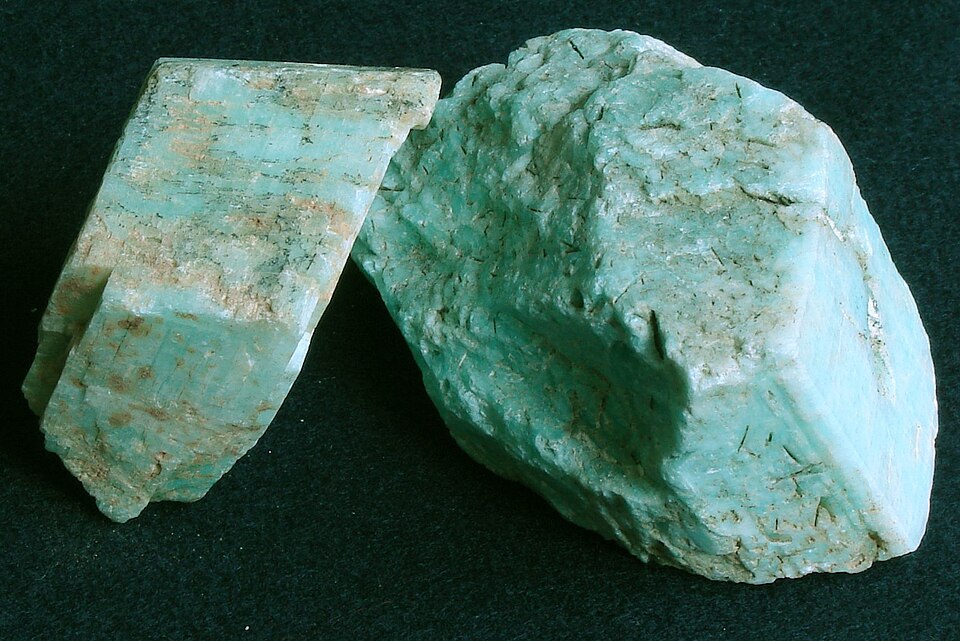
Amazonite properties at a glance
| Type | Minerals |
|---|---|
| Chemical formula | KAlSi3O8 |
| Mohs hardness | 6 |
| Crystal system | triclinic |
| Luster | vitreous |
| Streak | White |
| Cleavage | Perfect |
| Fracture | Uneven |
| Specific gravity | 2.56 |
| Transparency | opaque |
| Common colors | Blue-Green, Turquoise, Green |
| Rarity | uncommon |
Geology & background
Forms in granite pegmatites. The blue-green color is caused by small quantities of lead and water.
Found in Egyptian tombs, including that of Tutankhamun, and used in ancient South American cultures.
How to identify Amazonite
- Check whether the specimen's color and texture match typical Amazonite examples.
- Photograph a fresh surface in natural light and avoid shadows, glare, or wet surfaces.
- Use hardness, streak, luster, grain size, and locality together; no single trait is enough for every specimen.
Full Amazonite identification guide: checklist, home tests and look-alikes →
Amazonite vs similar stones
Not sure it isn't something else? Side-by-side comparisons with the stones most often confused with Amazonite.
Where Amazonite is found
Amazonite is reported from multiple localities or geological settings. Exact locality should be verified from specimen provenance, maps, or field notes.
How much is Amazonite worth?
| Entry-level specimen | $5 |
|---|---|
| Typical collector specimen | $25 |
| Premium specimen | $150+ |
Value depends on size, condition, color, crystal quality, locality, rarity, preparation, and provenance. Treat this as educational guidance, not an appraisal.
Common uses
- Jewelry
- Decorative objects
- Carvings
Interesting facts
- Named after the Amazon River despite not being found there
- Used by ancient Egyptians in jewelry and carvings
- Colorado is famous for its amazonite specimens
Care & safety
Treat Amazonite as a collector specimen unless hardness, cleavage, and fracture are confirmed.
Avoid inhaling dust. Do not cut, grind, or polish unknown specimens without eye protection and a properly rated respirator.
Amazonite FAQ
What is Amazonite?
Amazonite is a green to blue-green variety of microcline feldspar. Despite its name, it's not found in the Amazon but was named for its color similarity to the river.
How much is Amazonite worth?
Entry-level Amazonite specimens sell for around $5, a typical collector specimen for about $25, and premium pieces for $150 or more. Value depends on size, condition, color, crystal quality, locality, rarity, preparation, and provenance. Treat this as educational guidance, not an appraisal.
How hard is Amazonite?
Amazonite has a Mohs hardness of 6. It is about as hard as window glass: a knife barely marks it, while a steel file (Mohs 6.5) will.
Where is Amazonite found?
Notable sources of Amazonite include Colorado, USA, Russia, Brazil, Madagascar, and Ethiopia. Forms in granite pegmatites.
What is Amazonite used for?
Amazonite is used for jewelry, decorative objects, and carvings.