Minerals · common
Astrophyllite
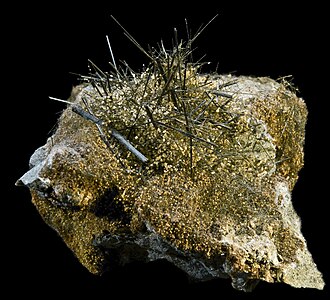
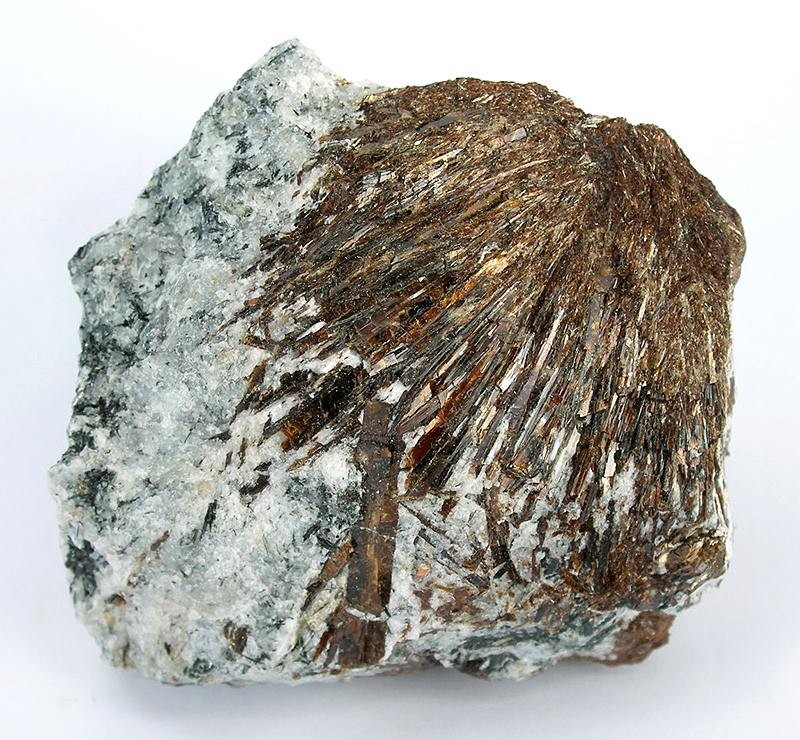
Astrophyllite is a rare, structurally complex silicate of potassium, sodium, iron, titanium, and manganese that forms bronze to golden-brown bladed or feathery crystal sprays. Its name, from the Greek for star leaf, describes the radiating star-like clusters it builds within alkaline igneous rocks. The mineral is prized more for its striking metallic sheen and habit than for gem use, since it never occurs transparent.
Astrophyllite properties at a glance
| Type | Minerals |
|---|---|
| Chemical formula | (K,Na)3(Fe,Mn)7Ti2Si8O24(OH)4F |
| Mohs hardness | 3–3.5 |
| Crystal system | Triclinic |
| Luster | Vitreous to pearly/submetallic sheen |
| Streak | Brownish yellow |
| Cleavage | Perfect basal {001} (micaceous) |
| Fracture | Uneven |
| Specific gravity | 3.3–3.4 |
| Transparency | Translucent |
| Common colors | Golden-yellow, Bronze, Copper-red, Brown |
| Rarity | common |
Geology & background
Astrophyllite crystallizes late in alkaline igneous complexes, particularly nepheline syenites and related pegmatites, where residual fluids rich in rare alkalis and titanium concentrate before final solidification. The classic locality is the Khibiny and Lovozero massifs on Russia's Kola Peninsula, source of the finest radiating sprays set in gray feldspathic matrix. Other notable occurrences include Mont Saint-Hilaire in Quebec and the Eldor complex in Colorado, both alkaline intrusions known for producing unusual accessory minerals.
Specimens are usually collected as slabbed or polished matrix pieces showing golden blades fanning through contrasting groundmass, a display style that shows off the mineral's habit better than loose crystals would. Because astrophyllite is soft, brittle, and rarely gem quality, its market value depends heavily on the aesthetics of the spray pattern and matrix contrast rather than clarity or size. Collectors of alkaline-rock minerals often pair astrophyllite pieces with associated species like aegirine, eudialyte, or nepheline from the same deposit.
How to identify Astrophyllite
Astrophyllite forms bronze, golden, or reddish-brown bladed to feathery crystals with a metallic to pearly luster arranged in radiating star-shaped sprays. Its streak is pale yellow-brown, and it has one perfect cleavage direction with a hardness around 3, soft enough to gouge easily but not scratch glass. The radiating, almost feather-like habit set against pale feldspar matrix is the key identifying feature, separating it from similarly colored micas or amphiboles, which never form true star-burst clusters.
- Compare the specimen's color, luster, crystal habit, grain size, streak, and locality before confirming.
- Use multiple photos when possible, including a fresh surface and a close view of texture.
Full Astrophyllite identification guide: checklist, home tests and look-alikes →
Astrophyllite vs similar stones
Not sure it isn't something else? Side-by-side comparisons with the stones most often confused with Astrophyllite.
Where Astrophyllite is found
Reported from multiple localities worldwide; verify locality against specimen provenance when available.
How much is Astrophyllite worth?
| Entry-level specimen | $2 |
|---|---|
| Typical collector specimen | $20 |
| Premium specimen | $150+ |
Value depends on size, crystal quality, color, locality, rarity, damage, and provenance.
Common uses
- Collector specimens
- Education
- Field identification
- Industrial or lapidary use when suitable
Interesting facts
- Astrophyllite's Greek-derived name literally translates to star leaf, describing its radiating spray-like crystal clusters.
- Fine specimens come almost exclusively from a handful of alkaline igneous complexes worldwide, including Russia's Kola Peninsula.
- Dealers sometimes nickname the mineral star leaf stone in the trade for its resemblance to metallic foliage.
Care & safety
Handle as a collector specimen until hardness, cleavage, and fracture are verified.
Avoid inhaling dust. Do not cut, grind, or polish unknown specimens without eye protection and a proper respirator.
Astrophyllite FAQ
What is Astrophyllite?
Astrophyllite is a rare, structurally complex silicate of potassium, sodium, iron, titanium, and manganese that forms bronze to golden-brown bladed or feathery crystal sprays. Its name, from the Greek for star leaf, describes the radiating star-like clusters it builds within alkaline igneous rocks. The mineral is prized more for its striking metallic sheen and habit than for gem use, since it never occurs transparent.
How much is Astrophyllite worth?
Entry-level Astrophyllite specimens sell for around $2, a typical collector specimen for about $20, and premium pieces for $150 or more. Value depends on size, crystal quality, color, locality, rarity, damage, and provenance.
How hard is Astrophyllite?
Astrophyllite has a Mohs hardness of 3–3.5. A copper coin (Mohs 3.5) scratches it, but a fingernail does not.
What is Astrophyllite used for?
Astrophyllite is used for collector specimens, education, field identification, and industrial or lapidary use when suitable.