Minerals · common
Benitoite
Benitoite is a rare barium titanium silicate, BaTiSi3O9, notable as one of the few minerals crystallizing in the ditrigonal-dipyramidal class of the hexagonal system. It is best known for its vivid sapphire-blue color and its powerful blue fluorescence under shortwave ultraviolet light. First described in 1907 from California's San Benito County, it later became the official state gemstone of California.
Benitoite properties at a glance
| Type | Minerals |
|---|---|
| Chemical formula | BaTiSi3O9 |
| Mohs hardness | 6–6.5 |
| Crystal system | Trigonal |
| Luster | Vitreous |
| Streak | White |
| Cleavage | Poor, two directions |
| Fracture | Conchoidal to uneven |
| Specific gravity | 3.6–3.7 |
| Transparency | Transparent |
| Common colors | Blue, Colorless, Pink, White |
| Rarity | common |
Geology & background
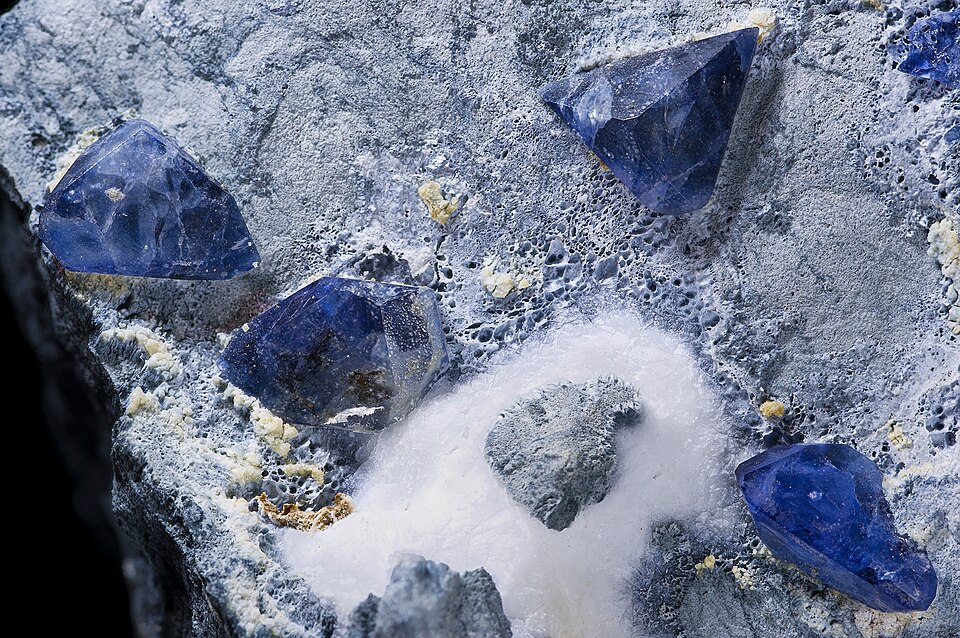
Benitoite forms in an unusual setting: veins of natrolite cutting through serpentinite that underwent low-temperature, high-pressure blueschist-facies metamorphism along an ancient subduction zone. The type locality near the headwaters of San Benito River remains essentially the only commercially significant source of gem-quality material anywhere, making it one of the more geographically restricted gemstones known. Trace occurrences have since turned up in Japan and Arkansas, though none rival the California deposit in size or crystal quality. Collectors seek benitoite both as cut gems and as sharp, glassy crystals still attached to natrolite matrix, since detached crystals often fetch less than matrix pieces showing natural growth. Its strong pleochroism means the blue intensity shifts with viewing angle, and its bright shortwave UV fluorescence is often used to spot fragments in mine tailings.
How to identify Benitoite
Benitoite occurs as flattened, triangular to pseudo-hexagonal crystals with a vitreous luster, typically sapphire-blue but sometimes colorless or violet toward the crystal center. Hardness is 6 to 6.5, streak is white, and fracture is conchoidal with no distinct cleavage. Its association with white natrolite veins in dark serpentinite, along with vivid blue shortwave UV fluorescence, quickly separates it from sapphire and blue tourmaline, which do not glow the same way and never occur in that matrix.
- Compare the specimen's color, luster, crystal habit, grain size, streak, and locality before confirming.
- Use multiple photos when possible, including a fresh surface and a close view of texture.
Full Benitoite identification guide: checklist, home tests and look-alikes →
Benitoite vs similar stones
Not sure it isn't something else? Side-by-side comparisons with the stones most often confused with Benitoite.
Where Benitoite is found
Reported from multiple localities worldwide; verify locality against specimen provenance when available.
How much is Benitoite worth?
| Entry-level specimen | $2 |
|---|---|
| Typical collector specimen | $20 |
| Premium specimen | $150+ |
Value depends on size, crystal quality, color, locality, rarity, damage, and provenance.
Common uses
- Collector specimens
- Education
- Field identification
- Industrial or lapidary use when suitable
Interesting facts
- Benitoite was named California's official state gemstone in 1985, honoring a stone found almost nowhere else on Earth.
- Under shortwave ultraviolet light, benitoite glows a vivid electric blue, a trait miners have used to find fragments in waste rock.
- The mineral forms in natrolite veins within serpentinite that experienced blueschist metamorphism, a rare high-pressure, low-temperature setting tied to ancient subduction.
Care & safety
Handle as a collector specimen until hardness, cleavage, and fracture are verified.
Avoid inhaling dust. Do not cut, grind, or polish unknown specimens without eye protection and a proper respirator.
Benitoite FAQ
What is Benitoite?
Benitoite is a rare barium titanium silicate, BaTiSi3O9, notable as one of the few minerals crystallizing in the ditrigonal-dipyramidal class of the hexagonal system. It is best known for its vivid sapphire-blue color and its powerful blue fluorescence under shortwave ultraviolet light. First described in 1907 from California's San Benito County, it later became the official state gemstone of California.
How much is Benitoite worth?
Entry-level Benitoite specimens sell for around $2, a typical collector specimen for about $20, and premium pieces for $150 or more. Value depends on size, crystal quality, color, locality, rarity, damage, and provenance.
How hard is Benitoite?
Benitoite has a Mohs hardness of 6–6.5. It is about as hard as window glass: a knife barely marks it, while a steel file (Mohs 6.5) will.
What is Benitoite used for?
Benitoite is used for collector specimens, education, field identification, and industrial or lapidary use when suitable.