Minerals · common
Charoite
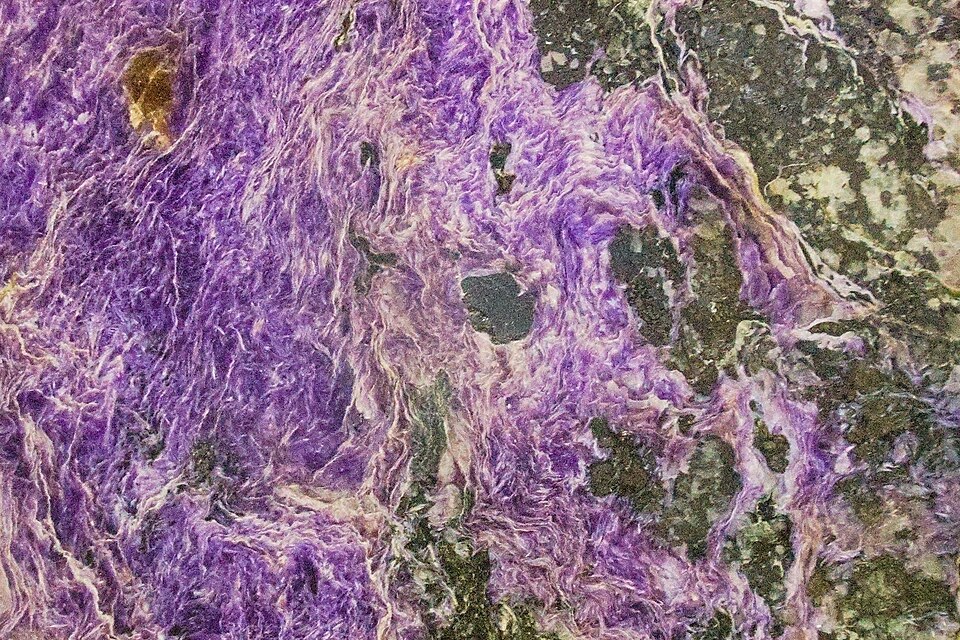
Charoite is a rare silicate mineral known for its swirling lavender to deep purple color and fibrous, interlocking crystal structure that produces a silky, almost pearly chatoyance. Its complex formula involves potassium, sodium, calcium, and silicon, and until recently it was found at only a single locality on Earth. The intricate mottled patterns of purple, white, and black seen in polished charoite come from intergrown veins of the mineral with aegirine and microcline.
Charoite properties at a glance
| Type | Minerals |
|---|---|
| Chemical formula | (K,Sr)15(Ca,Na)32Si70(O,OH)180(OH,F)4·nH2O |
| Mohs hardness | 5–6 |
| Crystal system | Monoclinic |
| Luster | Vitreous to pearly/silky |
| Streak | White |
| Cleavage | Perfect in two directions |
| Fracture | Uneven to splintery |
| Specific gravity | 2.54–2.68 |
| Transparency | Translucent to opaque |
| Common colors | Lilac, Purple, Violet with white/black veining |
| Rarity | common |
Geology & background
Charoite was first described in the 1970s from the Chara River region of Siberia, near the Murun massif in Russia, where it formed through metasomatic reactions between an alkaline syenite intrusion and adjacent limestone. This remains essentially the only commercially significant source anywhere, making charoite one of the more geographically restricted ornamental minerals in existence. Its formation required an unusual pairing of alkali-rich fluids with carbonate country rock, a geologic coincidence rarely duplicated elsewhere.
Rockhounds and lapidaries value charoite chiefly as a cabochon and carving material, prized for its swirling, silk-like texture and rich purple tones that often include contrasting black aegirine needles and pale feldspar patches. Because it all comes from one restricted region, supply can fluctuate, and dyed or imitation material has shown up in the market, so buyers should look for genuine chatoyant fiber structure. Its relative softness suits cabochons and beads well but makes it less durable for rings subject to daily wear.
How to identify Charoite
Charoite shows a lavender to violet-purple color, often swirled with white, gray, or black patches, with a silky to pearly luster caused by its fibrous crystal structure. Its streak is white to pale lilac, hardness falls around 5 to 6, and it lacks a distinct single cleavage, instead showing a fibrous, splintery fracture. The intertwined, chatoyant fiber texture visible under light is the best identifying feature, distinguishing it from imitations like dyed quartzite. It is sometimes confused with sugilite because of similar coloring.
- Compare the specimen's color, luster, crystal habit, grain size, streak, and locality before confirming.
- Use multiple photos when possible, including a fresh surface and a close view of texture.
Full Charoite identification guide: checklist, home tests and look-alikes →
Charoite vs similar stones
Not sure it isn't something else? Side-by-side comparisons with the stones most often confused with Charoite.
Where Charoite is found
Reported from multiple localities worldwide; verify locality against specimen provenance when available.
How much is Charoite worth?
| Entry-level specimen | $2 |
|---|---|
| Typical collector specimen | $20 |
| Premium specimen | $150+ |
Value depends on size, crystal quality, color, locality, rarity, damage, and provenance.
Common uses
- Collector specimens
- Education
- Field identification
- Industrial or lapidary use when suitable
Interesting facts
- Charoite was not formally recognized as a distinct mineral until the 1970s, making it a relatively recent addition to mineralogy.
- Essentially all charoite on the market traces back to a single deposit near the Chara River in Siberia.
- Its name is often said to derive from the Russian word for charm or magic, fitting for a stone treasured for its swirling patterns.
Care & safety
Handle as a collector specimen until hardness, cleavage, and fracture are verified.
Avoid inhaling dust. Do not cut, grind, or polish unknown specimens without eye protection and a proper respirator.
Charoite FAQ
What is Charoite?
Charoite is a rare silicate mineral known for its swirling lavender to deep purple color and fibrous, interlocking crystal structure that produces a silky, almost pearly chatoyance. Its complex formula involves potassium, sodium, calcium, and silicon, and until recently it was found at only a single locality on Earth. The intricate mottled patterns of purple, white, and black seen in polished charoite come from intergrown veins of the mineral with aegirine and microcline.
How much is Charoite worth?
Entry-level Charoite specimens sell for around $2, a typical collector specimen for about $20, and premium pieces for $150 or more. Value depends on size, crystal quality, color, locality, rarity, damage, and provenance.
How hard is Charoite?
Charoite has a Mohs hardness of 5–6. It is about as hard as window glass: a knife barely marks it, while a steel file (Mohs 6.5) will.
What is Charoite used for?
Charoite is used for collector specimens, education, field identification, and industrial or lapidary use when suitable.