Minerals · common
Dioptase
Dioptase is a copper cyclosilicate mineral, Cu6Si6O18·6H2O, prized for an intense emerald-green color that rivals fine emerald despite being a completely different mineral species. It forms in the oxidized zones of copper ore deposits under arid conditions, typically as small but brilliantly lustrous crystals. Dioptase is too soft and brittle to be widely used as a gemstone, so its value lies almost entirely with mineral collectors.
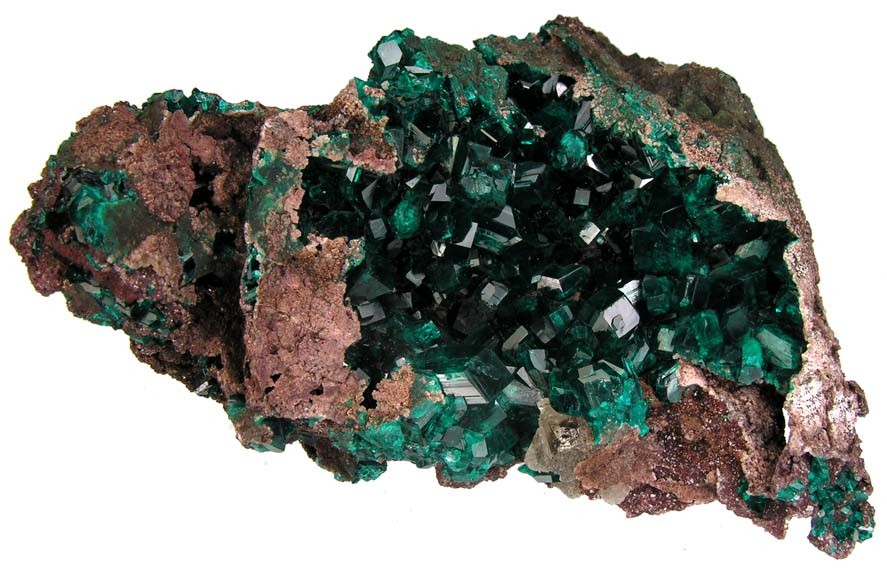
Dioptase properties at a glance
| Type | Minerals |
|---|---|
| Chemical formula | CuSiO3·H2O |
| Mohs hardness | 5 |
| Crystal system | Trigonal |
| Luster | Vitreous |
| Streak | Green |
| Cleavage | Perfect rhombohedral |
| Fracture | Conchoidal to uneven |
| Specific gravity | 3.28–3.35 |
| Transparency | Transparent to translucent |
| Common colors | Emerald green, Bluish green |
| Rarity | common |
Geology & background
Dioptase crystallizes in hydrothermal veins and cavities within the oxidized portions of copper deposits, forming where copper-bearing solutions react with silica under low-temperature, near-surface conditions, most commonly in arid or semi-arid climates favorable to secondary copper minerals. The Altyn-Tyube deposit in Kazakhstan first brought dioptase to European mineralogical attention in the eighteenth century, while the Tsumeb mine in Namibia and deposits in the Congo have since produced some of the finest, most vividly colored crystal clusters.
Collectors seek dioptase specifically for its saturated green color, more vivid than many true emeralds, and for its habit of forming druzy crusts of small, sharp rhombohedral crystals on matrix. Because the mineral is relatively soft and has perfect cleavage in three directions, cutting faceted gemstones from it is difficult and results in a fragile finished stone, so most dioptase remains valued as natural crystal specimens rather than jewelry material.
How to identify Dioptase
Dioptase forms small, glassy, rhombohedral crystals of vivid emerald to bluish-green color with a vitreous luster and a pale green streak. Its hardness of 5 makes it noticeably softer than true emerald, and it has perfect cleavage in three directions, causing crystals to break apart easily under pressure. It typically occurs as druzy crusts on matrix rather than large single crystals. Dioptase is distinguished from emerald primarily by its lower hardness, brittleness, and the cleavage that emerald, a form of beryl, does not share.
- Compare the specimen's color, luster, crystal habit, grain size, streak, and locality before confirming.
- Use multiple photos when possible, including a fresh surface and a close view of texture.
Full Dioptase identification guide: checklist, home tests and look-alikes →
Dioptase vs similar stones
Not sure it isn't something else? Side-by-side comparisons with the stones most often confused with Dioptase.
Where Dioptase is found
Reported from multiple localities worldwide; verify locality against specimen provenance when available.
How much is Dioptase worth?
| Entry-level specimen | $2 |
|---|---|
| Typical collector specimen | $20 |
| Premium specimen | $150+ |
Value depends on size, crystal quality, color, locality, rarity, damage, and provenance.
Common uses
- Collector specimens
- Education
- Field identification
- Industrial or lapidary use when suitable
Interesting facts
- Dioptase's saturated green color is often more intense than that of natural emerald, despite being a chemically unrelated copper mineral.
- The mineral was first described scientifically from a Kazakhstan deposit discovered in the mid-eighteenth century.
- Perfect cleavage in three directions makes dioptase crystals so fragile that faceted gemstones cut from it are exceedingly rare.
Care & safety
Handle as a collector specimen until hardness, cleavage, and fracture are verified.
Avoid inhaling dust. Do not cut, grind, or polish unknown specimens without eye protection and a proper respirator.
Dioptase FAQ
What is Dioptase?
Dioptase is a copper cyclosilicate mineral, Cu6Si6O18·6H2O, prized for an intense emerald-green color that rivals fine emerald despite being a completely different mineral species. It forms in the oxidized zones of copper ore deposits under arid conditions, typically as small but brilliantly lustrous crystals. Dioptase is too soft and brittle to be widely used as a gemstone, so its value lies almost entirely with mineral collectors.
How much is Dioptase worth?
Entry-level Dioptase specimens sell for around $2, a typical collector specimen for about $20, and premium pieces for $150 or more. Value depends on size, crystal quality, color, locality, rarity, damage, and provenance.
How hard is Dioptase?
Dioptase has a Mohs hardness of 5. A steel knife blade (Mohs 5.5) scratches it; a copper coin does not.
What is Dioptase used for?
Dioptase is used for collector specimens, education, field identification, and industrial or lapidary use when suitable.