Minerals · common
Hessonite
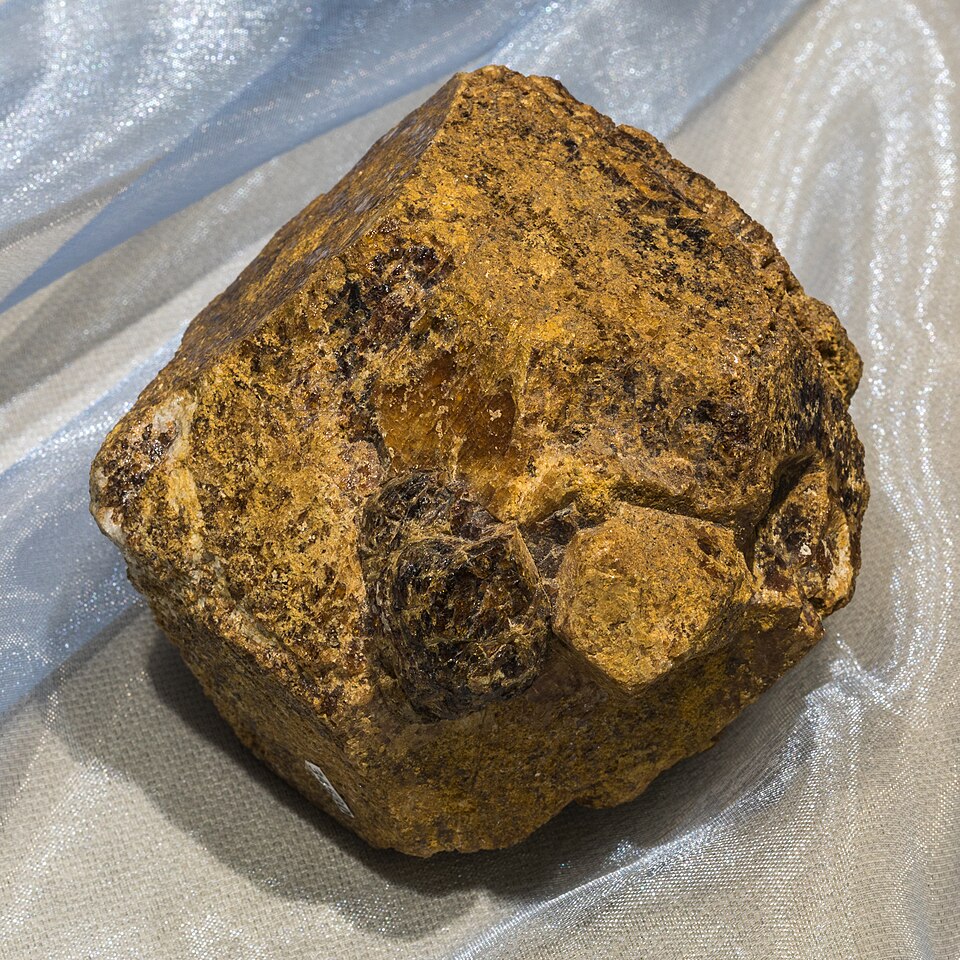
Hessonite is a warm orange-brown to reddish-brown variety of grossular garnet, Ca3Al2(SiO4)3, colored by trace iron and manganese, and long prized in South Asian gem traditions under the Sanskrit name gomedh. Its slightly greasy internal luster and swirling, treacle-like inclusions, often described as a scotch-in-water effect, set it apart from other orange garnets and gemstones. It belongs to the calcium-aluminum garnet subgroup rather than the calcium-iron subgroup that includes andradite.
Hessonite properties at a glance
| Type | Minerals |
|---|---|
| Chemical formula | Ca3Al2(SiO4)3 |
| Mohs hardness | 6.5–7 |
| Crystal system | Cubic |
| Luster | Vitreous to resinous |
| Streak | White |
| Cleavage | None |
| Fracture | Conchoidal to uneven |
| Specific gravity | 3.5–3.65 |
| Transparency | Transparent to translucent |
| Common colors | Orange-brown, Cinnamon, Yellow-orange, Reddish brown |
| Rarity | common |
Geology & background
Hessonite forms through contact metamorphism of impure limestones, where calcium- and aluminum-rich fluids react with the surrounding rock to build skarn deposits, a setting shared with other grossular varieties like tsavorite. It also turns up in gem gravels formed by the erosion and reworking of such metamorphic rocks. The most significant sources of gem-quality hessonite are Sri Lanka's gem gravels, along with occurrences in Canada, Brazil, and parts of East Africa.
In Vedic astrology, hessonite is associated with the shadow planet Rahu and remains one of the nine traditional gemstones, or navaratna, giving it strong cultural demand beyond ordinary mineral collecting. Gemologists identify it partly by its distinctive internal swirling or heat-wave texture, caused by variations in refractive index within the crystal, which sets it apart from cleaner orange gems like spessartine garnet or citrine. Because hessonite lacks cleavage, cutters must work carefully around internal strain to avoid fractures during faceting.
How to identify Hessonite
Hessonite shows warm orange, brown, or reddish-orange color with a vitreous to slightly resinous luster and a white streak despite its saturated body color. Hardness falls around 7 to 7.5, it has no cleavage, and it breaks with a conchoidal to uneven fracture, forming dodecahedral crystals or waterworn gem gravel pebbles. A useful identifying trait is its characteristic swirled, oily-looking internal texture visible under magnification. It is frequently confused with spessartine garnet, citrine quartz, or orange zircon.
- Compare the specimen's color, luster, crystal habit, grain size, streak, and locality before confirming.
- Use multiple photos when possible, including a fresh surface and a close view of texture.
Full Hessonite identification guide: checklist, home tests and look-alikes →
Hessonite vs similar stones
Not sure it isn't something else? Side-by-side comparisons with the stones most often confused with Hessonite.
Where Hessonite is found
Reported from multiple localities worldwide; verify locality against specimen provenance when available.
How much is Hessonite worth?
| Entry-level specimen | $2 |
|---|---|
| Typical collector specimen | $20 |
| Premium specimen | $150+ |
Value depends on size, crystal quality, color, locality, rarity, damage, and provenance.
Common uses
- Collector specimens
- Education
- Field identification
- Industrial or lapidary use when suitable
Interesting facts
- Hessonite has been used for centuries in South Asian jewelry and astrology, traditionally linked to the shadow planet Rahu.
- Its nickname among gemologists, the cinnamon stone, refers to its warm spicy orange-brown coloring.
- The swirling internal texture often seen in hessonite, sometimes compared to scotch stirred in water, comes from subtle variations within the crystal's structure.
Care & safety
Handle as a collector specimen until hardness, cleavage, and fracture are verified.
Avoid inhaling dust. Do not cut, grind, or polish unknown specimens without eye protection and a proper respirator.
Hessonite FAQ
What is Hessonite?
Hessonite is a warm orange-brown to reddish-brown variety of grossular garnet, Ca3Al2(SiO4)3, colored by trace iron and manganese, and long prized in South Asian gem traditions under the Sanskrit name gomedh. Its slightly greasy internal luster and swirling, treacle-like inclusions, often described as a scotch-in-water effect, set it apart from other orange garnets and gemstones. It belongs to the calcium-aluminum garnet subgroup rather than the calcium-iron subgroup that includes andradite.
How much is Hessonite worth?
Entry-level Hessonite specimens sell for around $2, a typical collector specimen for about $20, and premium pieces for $150 or more. Value depends on size, crystal quality, color, locality, rarity, damage, and provenance.
How hard is Hessonite?
Hessonite has a Mohs hardness of 6.5–7. It scratches glass and a steel knife and cannot be scratched by a steel file.
What is Hessonite used for?
Hessonite is used for collector specimens, education, field identification, and industrial or lapidary use when suitable.