Silicate Minerals · rare
Lazurite
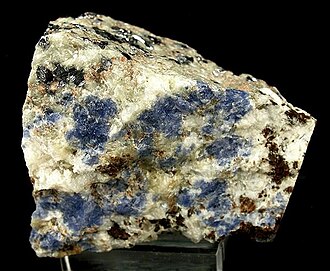
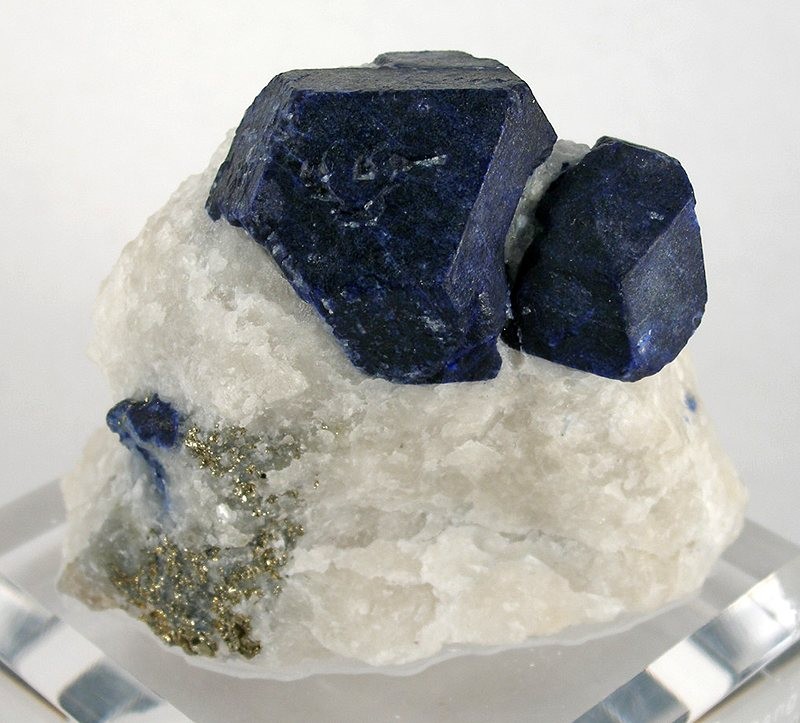
Lazurite is a deep blue feldspathoid mineral of the sodalite group and the main coloring component of the rock lapis lazuli. It occurs as rounded grains and rare dodecahedral crystals in metamorphosed limestone.
Also known as: Lapis lazuli mineral.
Lazurite properties at a glance
| Type | Silicate Minerals |
|---|---|
| Chemical formula | Na7Ca(Al6Si6O24)(SO4)(S3)·H2O |
| Mohs hardness | 5.25 |
| Crystal system | cubic |
| Luster | vitreous |
| Streak | Light blue |
| Cleavage | Imperfect |
| Fracture | Uneven to conchoidal |
| Specific gravity | 2.4 |
| Transparency | translucent |
| Common colors | Blue, Deep blue, Azure blue, Violet blue |
| Rarity | rare |
Geology & background
Lazurite forms by contact metamorphism of limestone, crystallizing in marbles where sulfur-rich fluids react with aluminosilicate material.
Lazurite, through lapis lazuli, supplied the prized blue pigment ultramarine used in manuscripts and Renaissance paintings, and the rock was carved and traded as a luxury material for thousands of years.
How to identify Lazurite
- Look for an intense azure-blue mineral occurring in white marble, often alongside brassy pyrite grains.
- Lazurite leaves a pale blue streak and is moderately hard, scratching glass with difficulty.
- Distinguish it from lazulite by its softer feel and marble host, and from azurite by its lack of reaction to acid.
Full Lazurite identification guide: checklist, home tests and look-alikes →
Lazurite vs similar stones
Not sure it isn't something else? Side-by-side comparisons with the stones most often confused with Lazurite.
Where Lazurite is found
Lazurite occurs in contact-metamorphosed marbles, with notable sources in Afghanistan, Russia, Chile, Tajikistan, and the United States.
How much is Lazurite worth?
| Entry-level specimen | $10 |
|---|---|
| Typical collector specimen | $80 |
| Premium specimen | $600+ |
Value depends on color intensity, crystal form, size, locality, aesthetics, damage, and provenance.
Common uses
- Source of lapis lazuli
- Historic ultramarine pigment
- Carvings and ornaments
- Lapidary cabochons
- Collector specimens
Interesting facts
- Lazurite is the principal blue mineral in lapis lazuli, the rock long mined for the pigment ultramarine.
- Natural ultramarine, made by grinding lazurite-rich lapis, was once more costly than gold.
- Lazurite owes its intense blue to sulfur trapped within its aluminosilicate framework.
- Well-formed lazurite crystals are uncommon, so most material is seen as massive blue grains.
Care & safety
Lazurite is moderately hard but can chip, and its color may fade with prolonged intense light or heat.
Avoid inhaling dust. Do not cut, grind, or polish unknown specimens without eye protection and a proper respirator.
Lazurite FAQ
What is Lazurite?
Lazurite is a deep blue feldspathoid mineral of the sodalite group and the main coloring component of the rock lapis lazuli. It occurs as rounded grains and rare dodecahedral crystals in metamorphosed limestone.
How much is Lazurite worth?
Entry-level Lazurite specimens sell for around $10, a typical collector specimen for about $80, and premium pieces for $600 or more. Value depends on color intensity, crystal form, size, locality, aesthetics, damage, and provenance.
How hard is Lazurite?
Lazurite has a Mohs hardness of 5.25. A steel knife blade (Mohs 5.5) scratches it; a copper coin does not.
Where is Lazurite found?
Notable sources of Lazurite include Afghanistan, Russia, Chile, Tajikistan, and United States. Lazurite forms by contact metamorphism of limestone, crystallizing in marbles where sulfur-rich fluids react with aluminosilicate material..
What is Lazurite used for?
Lazurite is used for source of lapis lazuli, historic ultramarine pigment, carvings and ornaments, lapidary cabochons, and collector specimens.