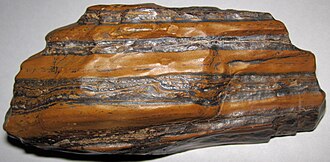
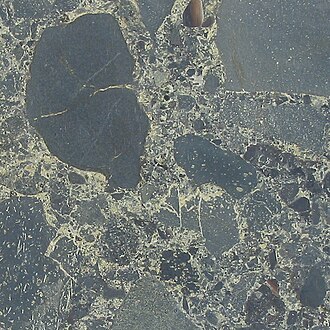
Sedimentary Rocks · uncommon
Mookaite
Mookaite is a colorful jasper-like trade material from Western Australia, usually showing mustard yellow, red, cream, brown, or purple patches.
Also known as: Mookaite Jasper, australian jasper, windalia radiolarite.
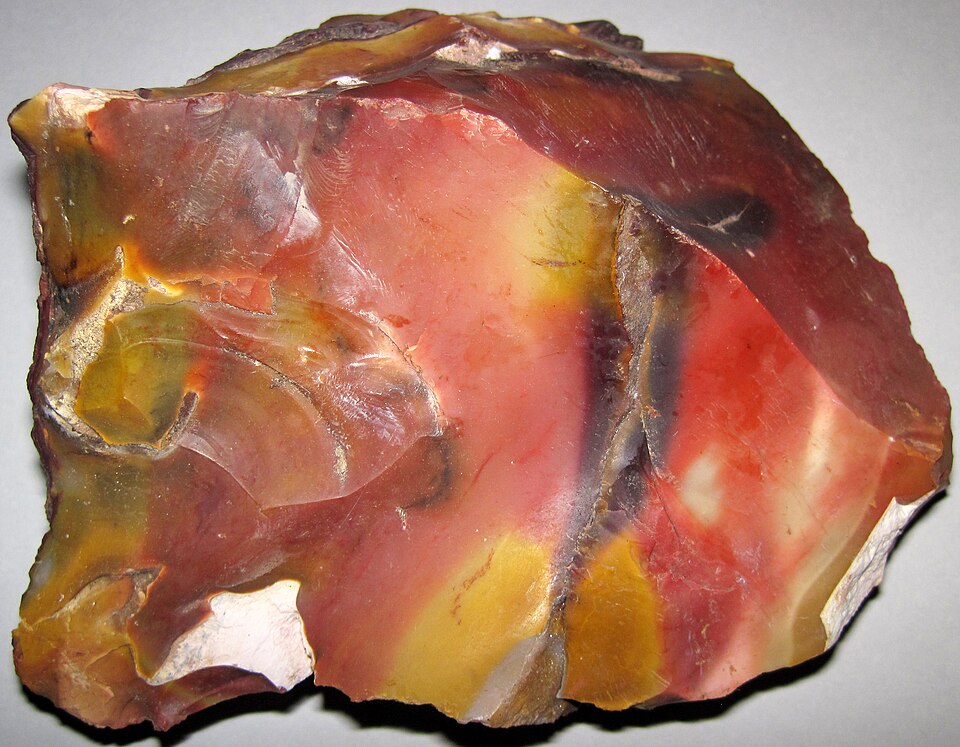
Mookaite properties at a glance
| Type | Sedimentary Rocks |
|---|---|
| Chemical formula | SiO2 dominant |
| Mohs hardness | 6.5 |
| Crystal system | amorphous |
| Luster | waxy |
| Streak | White |
| Cleavage | None |
| Fracture | Conchoidal to uneven |
| Specific gravity | 2.6 |
| Transparency | opaque |
| Common colors | Yellow, Red, Cream, Purple, Brown |
| Rarity | uncommon |
Geology & background
Forms as silicified radiolarite or jasper-like sedimentary material, with iron-rich impurities creating warm red, yellow, cream, and purple colors.
Mookaite is a modern lapidary trade material tied closely to Western Australian specimen and jewelry markets.
How to identify Mookaite
- Look for opaque patches of mustard yellow, red, cream, brown, or purple.
- Mookaite is usually massive and jasper-like rather than transparent or crystalline.
- Western Australian provenance supports the identification, but color pattern alone can overlap with other jaspers.
Full Mookaite identification guide: checklist, home tests and look-alikes →
Mookaite vs similar stones
Not sure it isn't something else? Side-by-side comparisons with the stones most often confused with Mookaite.
Where Mookaite is found
Mookaite is most strongly associated with Western Australia; verify locality when provenance matters.
How much is Mookaite worth?
| Entry-level specimen | $5 |
|---|---|
| Typical collector specimen | $25 |
| Premium specimen | $160+ |
Value depends on size, condition, color, pattern, locality, preparation, and provenance. Treat this as educational guidance, not an appraisal.
Common uses
- Cabochons
- Beads
- Tumbled stones
- Decorative objects
Interesting facts
- Mookaite is strongly associated with the Mooka Creek area of Western Australia.
- It is commonly cut into cabochons, beads, and tumbled stones.
- The trade name is often written as mookaite jasper.
Care & safety
Treat Mookaite as a collector specimen unless hardness, cleavage, and fracture are confirmed.
Avoid inhaling dust. Do not cut, grind, or polish unknown specimens without eye protection and a properly rated respirator.
Mookaite FAQ
What is Mookaite?
Mookaite is a colorful jasper-like trade material from Western Australia, usually showing mustard yellow, red, cream, brown, or purple patches.
How much is Mookaite worth?
Entry-level Mookaite specimens sell for around $5, a typical collector specimen for about $25, and premium pieces for $160 or more. Value depends on size, condition, color, pattern, locality, preparation, and provenance. Treat this as educational guidance, not an appraisal.
How hard is Mookaite?
Mookaite has a Mohs hardness of 6.5. It scratches glass and a steel knife and cannot be scratched by a steel file.
Where is Mookaite found?
Notable sources of Mookaite include Western Australia. Forms as silicified radiolarite or jasper-like sedimentary material, with iron-rich impurities creating warm red, yellow, cream, and purple colors..
What is Mookaite used for?
Mookaite is used for cabochons, beads, tumbled stones, and decorative objects.