Igneous Rocks · common
Snowflake Obsidian
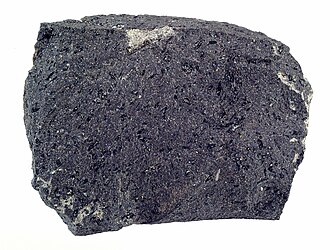
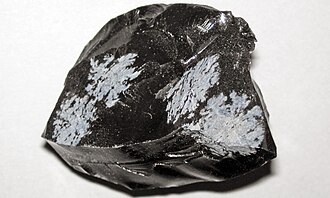
Snowflake obsidian is a black volcanic glass marked by gray-white spherulitic patches that resemble snowflakes. The pale clusters are crystals of cristobalite that grew as the originally glassy rock slowly began to crystallize.
Also known as: Flowering obsidian, Spherulitic obsidian.
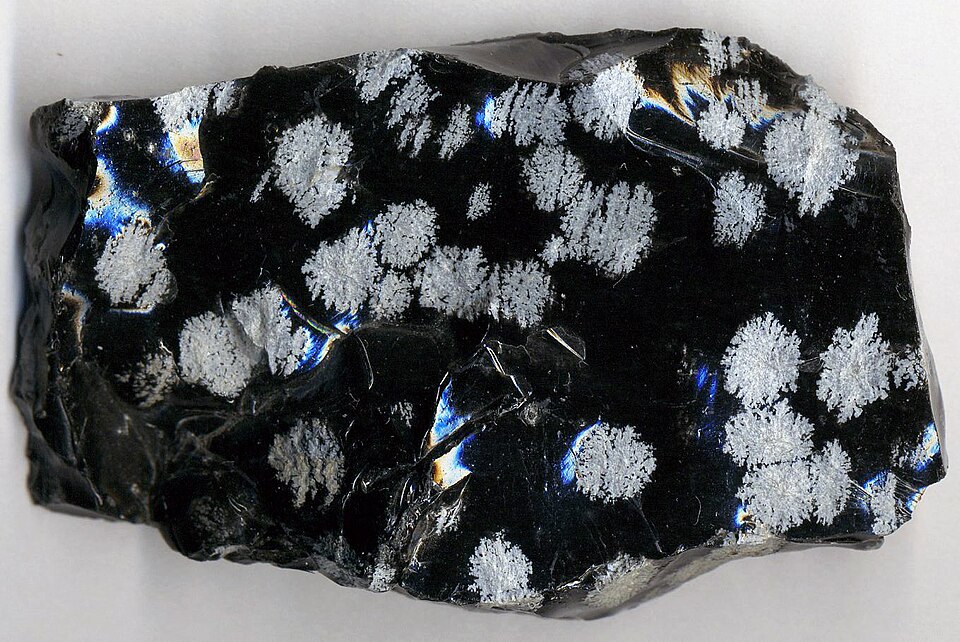
Snowflake Obsidian properties at a glance
| Type | Igneous Rocks |
|---|---|
| Mohs hardness | 5.5 |
| Luster | vitreous |
| Streak | White |
| Cleavage | None |
| Fracture | Conchoidal |
| Specific gravity | 2.4 |
| Transparency | opaque |
| Common colors | Black, Black and white |
| Rarity | common |
Geology & background
Snowflake obsidian forms when volcanic glass begins to devitrify, allowing small radiating clusters of cristobalite to crystallize and create pale snowflake-like patches within the black glass.
Obsidian has been used since prehistoric times for cutting tools, blades, and ornaments. Snowflake obsidian is valued today mainly as a decorative and lapidary material for its striking patterns.
How to identify Snowflake Obsidian
- Look for glossy black glass with gray-white snowflake-like patches and a conchoidal fracture.
- Snowflake obsidian is glassy with no crystal faces and no cleavage.
- The pale spherulites are embedded in the glass rather than sitting on the surface.
Full Snowflake Obsidian identification guide: checklist, home tests and look-alikes →
Snowflake Obsidian photos
Snowflake Obsidian vs similar stones
Not sure it isn't something else? Side-by-side comparisons with the stones most often confused with Snowflake Obsidian.
Where Snowflake Obsidian is found
Snowflake obsidian occurs in rhyolitic volcanic regions worldwide, with notable localities in the United States, Mexico, Iceland, Turkey, Italy, and Armenia.
How much is Snowflake Obsidian worth?
| Entry-level specimen | $3 |
|---|---|
| Typical collector specimen | $25 |
| Premium specimen | $120+ |
Value depends on size, polish, pattern contrast, snowflake distribution, and overall condition.
Common uses
- Cabochons and carved ornaments
- Beads and decorative objects
- Collector and display specimens
- Lapidary practice material
Interesting facts
- The snowflake patterns are spherulites, radiating clusters of the silica mineral cristobalite.
- Obsidian forms when lava cools so quickly that mineral crystals have little time to grow.
- The snowflakes mark the early stages of devitrification, as the glass slowly turns crystalline.
- Like all obsidian, it breaks with sharp conchoidal fractures and can hold a keen edge.
Care & safety
Snowflake obsidian is glass and can chip or fracture, producing sharp edges on impact.
Sharp edges and dust. Broken obsidian can produce extremely sharp edges; handle carefully and use eye protection and a respirator when cutting or grinding.
Snowflake Obsidian FAQ
What is Snowflake Obsidian?
Snowflake obsidian is a black volcanic glass marked by gray-white spherulitic patches that resemble snowflakes. The pale clusters are crystals of cristobalite that grew as the originally glassy rock slowly began to crystallize.
How much is Snowflake Obsidian worth?
Entry-level Snowflake Obsidian specimens sell for around $3, a typical collector specimen for about $25, and premium pieces for $120 or more. Value depends on size, polish, pattern contrast, snowflake distribution, and overall condition.
How hard is Snowflake Obsidian?
Snowflake Obsidian has a Mohs hardness of 5.5. It is about as hard as window glass: a knife barely marks it, while a steel file (Mohs 6.5) will.
Where is Snowflake Obsidian found?
Notable sources of Snowflake Obsidian include United States, Mexico, Iceland, Turkey, Italy, and Armenia. Snowflake obsidian forms when volcanic glass begins to devitrify, allowing small radiating clusters of cristobalite to crystallize and create pale snowflake-like patches within the black glass..
What is Snowflake Obsidian used for?
Snowflake Obsidian is used for cabochons and carved ornaments, beads and decorative objects, collector and display specimens, and lapidary practice material.