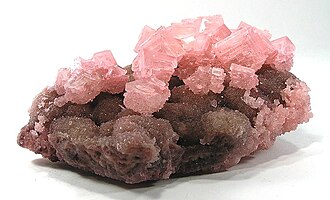
Borate Minerals · uncommon
Ulexite
Ulexite is a hydrated sodium calcium borate best known for its fibrous variety, which transmits light along its fibers. Sliced and polished plates project an image from the back surface, earning it the nickname television stone.
Also known as: Television stone, TV rock.
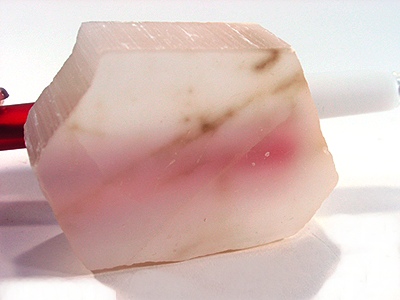
Ulexite properties at a glance
| Type | Borate Minerals |
|---|---|
| Chemical formula | NaCaB5O6(OH)6·5H2O |
| Mohs hardness | 2.5 |
| Crystal system | triclinic |
| Luster | vitreous |
| Streak | White |
| Cleavage | Perfect |
| Fracture | Uneven |
| Specific gravity | 1.95 |
| Transparency | translucent |
| Common colors | White, Colorless |
| Rarity | uncommon |
Geology & background
Ulexite forms by evaporation in arid borate-rich playa lakes and basins, where it commonly crystallizes as silky fibrous masses and rounded nodules within clay sediments.
Ulexite was named in 1850 after the German chemist Georg Ludwig Ulex. It became economically significant as a boron ore and a popular educational and novelty mineral because of its optical behavior.
How to identify Ulexite
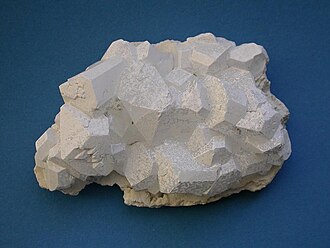
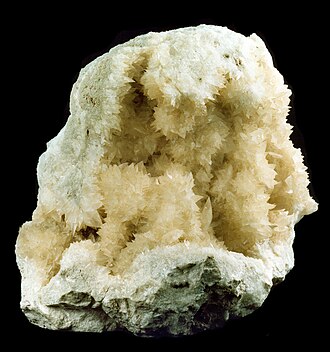
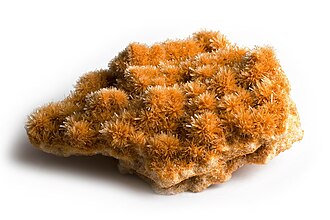
- Look for silky white fibrous masses or nodules that are very light in the hand.
- Fibrous slices that project an image from below are nearly diagnostic of ulexite.
- Low hardness near 2.5 and a low specific gravity support identification.
Full Ulexite identification guide: checklist, home tests and look-alikes →
Ulexite vs similar stones
Not sure it isn't something else? Side-by-side comparisons with the stones most often confused with Ulexite.
Where Ulexite is found
Ulexite occurs in arid borate evaporite deposits, with notable localities in the United States, Chile, Argentina, Peru, Kazakhstan, and Turkey.
How much is Ulexite worth?
| Entry-level specimen | $5 |
|---|---|
| Typical collector specimen | $25 |
| Premium specimen | $120+ |
Value depends on optical quality, size, polish, locality, damage, and overall aesthetics.
Common uses
- Boron ore
- Collector and novelty specimens
- Educational optics demonstrations
- Industrial borate source
Interesting facts
- Polished fibrous ulexite acts like natural fiber optics, projecting an image of whatever lies beneath it.
- Its nickname television stone comes from this light-transmitting fiber-optic behavior.
- Ulexite is so light it has a specific gravity below 2, lower than most common minerals.
- It is an important industrial ore of boron.
Care & safety
Ulexite is soft and fragile, and its fibers can separate or absorb moisture.
Avoid inhaling dust. Do not cut, grind, or polish unknown specimens without eye protection and a proper respirator.
Water soluble. Ulexite is slightly soluble and absorbs moisture, so keep specimens dry to prevent damage.
Ulexite FAQ
What is Ulexite?
Ulexite is a hydrated sodium calcium borate best known for its fibrous variety, which transmits light along its fibers. Sliced and polished plates project an image from the back surface, earning it the nickname television stone.
How much is Ulexite worth?
Entry-level Ulexite specimens sell for around $5, a typical collector specimen for about $25, and premium pieces for $120 or more. Value depends on optical quality, size, polish, locality, damage, and overall aesthetics.
How hard is Ulexite?
Ulexite has a Mohs hardness of 2.5. A copper coin (Mohs 3.5) scratches it, but a fingernail does not.
Where is Ulexite found?
Notable sources of Ulexite include United States, Chile, Argentina, Peru, Kazakhstan, and Turkey. Ulexite forms by evaporation in arid borate-rich playa lakes and basins, where it commonly crystallizes as silky fibrous masses and rounded nodules within clay sediments..
What is Ulexite used for?
Ulexite is used for boron ore, collector and novelty specimens, educational optics demonstrations, and industrial borate source.