Silicate Minerals · common
Moss Agate
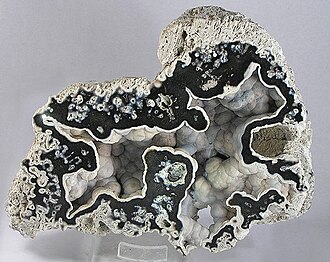
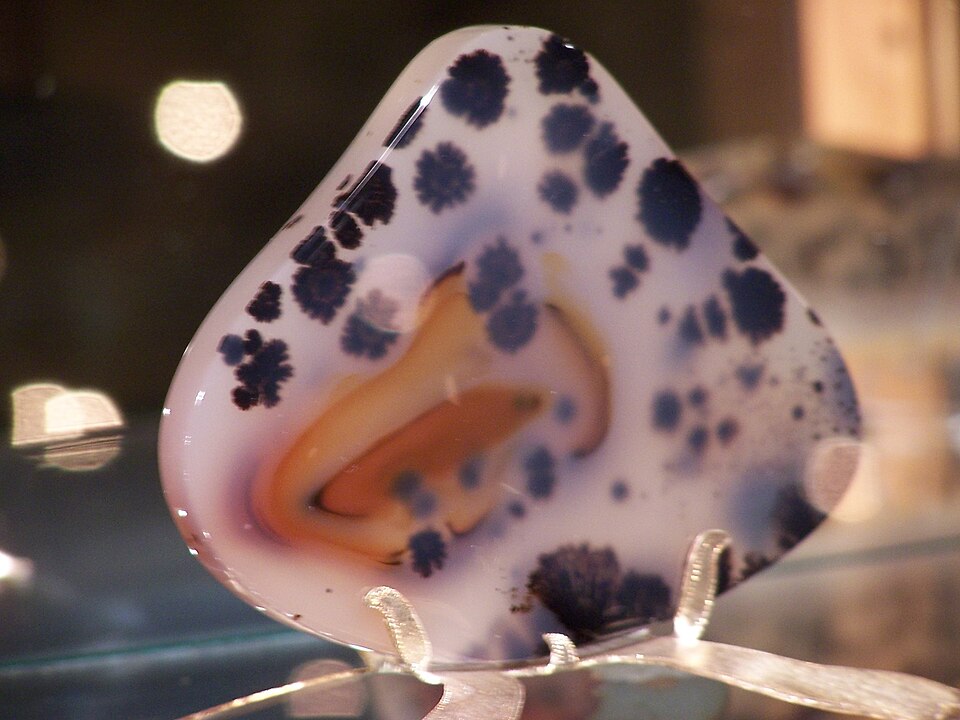
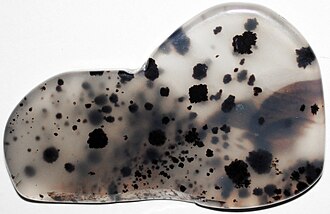
Moss agate is a translucent chalcedony filled with green, brown, or black mineral inclusions that resemble moss or foliage. Despite the name it contains no organic material, and it is widely cut for jewelry.
Also known as: Mocha stone.
Moss Agate properties at a glance
| Type | Silicate Minerals |
|---|---|
| Chemical formula | SiO2 |
| Mohs hardness | 6.75 |
| Crystal system | trigonal |
| Luster | vitreous |
| Streak | White |
| Cleavage | None |
| Fracture | Conchoidal |
| Specific gravity | 2.62 |
| Transparency | translucent |
| Common colors | Colorless, White, Green, Brown, Black |
| Rarity | common |
Geology & background
Moss agate is a variety of chalcedony in which silica-rich groundwater fills cavities and fractures, trapping iron and manganese oxide inclusions that grow into branching, plant-like patterns.
Moss agate has been used for ornament and carving since antiquity and became especially popular in eighteenth and nineteenth-century Europe for jewelry, seals, and decorative inlay.
How to identify Moss Agate
- Look for translucent chalcedony with green, brown, or black branching inclusions resembling moss or foliage.
- Moss agate is hard at about 6.5 to 7 with conchoidal fracture and no cleavage.
- Unlike classic agate it lacks concentric bands; the pattern comes from scattered mineral inclusions.
Full Moss Agate identification guide: checklist, home tests and look-alikes →
Moss Agate photos
Moss Agate vs similar stones
Not sure it isn't something else? Side-by-side comparisons with the stones most often confused with Moss Agate.
Where Moss Agate is found
Moss agate occurs in volcanic and sedimentary settings worldwide, with notable localities in the United States, India, Brazil, Australia, Uruguay, and China.
How much is Moss Agate worth?
| Entry-level specimen | $5 |
|---|---|
| Typical collector specimen | $30 |
| Premium specimen | $150+ |
Value depends on the clarity of inclusions, pattern appeal, color contrast, cut, and size of the piece.
Common uses
- Cabochons and jewelry
- Carvings and ornaments
- Beads
- Collector and lapidary material
- Decorative inlay
Interesting facts
- The 'moss' is made of mineral inclusions such as iron and manganese oxides, not actual plant matter.
- Moss agate is not strictly banded, so some mineralogists treat it as an included chalcedony rather than a true agate.
- It was once carried as a talisman by farmers and gardeners who linked it to good harvests.
- Montana along the Yellowstone River is a famous source of moss agate.
Care & safety
Moss agate is hard and tough, making it durable for everyday jewelry and handling.
Avoid inhaling dust. Do not cut, grind, or polish unknown specimens without eye protection and a proper respirator.
Moss Agate FAQ
What is Moss Agate?
Moss agate is a translucent chalcedony filled with green, brown, or black mineral inclusions that resemble moss or foliage. Despite the name it contains no organic material, and it is widely cut for jewelry.
How much is Moss Agate worth?
Entry-level Moss Agate specimens sell for around $5, a typical collector specimen for about $30, and premium pieces for $150 or more. Value depends on the clarity of inclusions, pattern appeal, color contrast, cut, and size of the piece.
How hard is Moss Agate?
Moss Agate has a Mohs hardness of 6.75. It scratches glass and a steel knife and cannot be scratched by a steel file.
Where is Moss Agate found?
Notable sources of Moss Agate include United States, India, Brazil, Australia, Uruguay, and China. Moss agate is a variety of chalcedony in which silica-rich groundwater fills cavities and fractures, trapping iron and manganese oxide inclusions that grow into branching, plant-like patterns..
What is Moss Agate used for?
Moss Agate is used for cabochons and jewelry, carvings and ornaments, beads, collector and lapidary material, and decorative inlay.