Native Elements · common
Sulfur
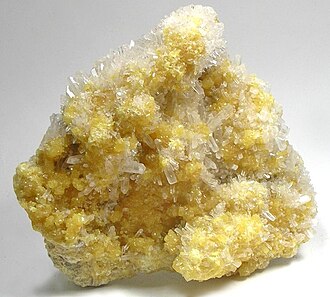
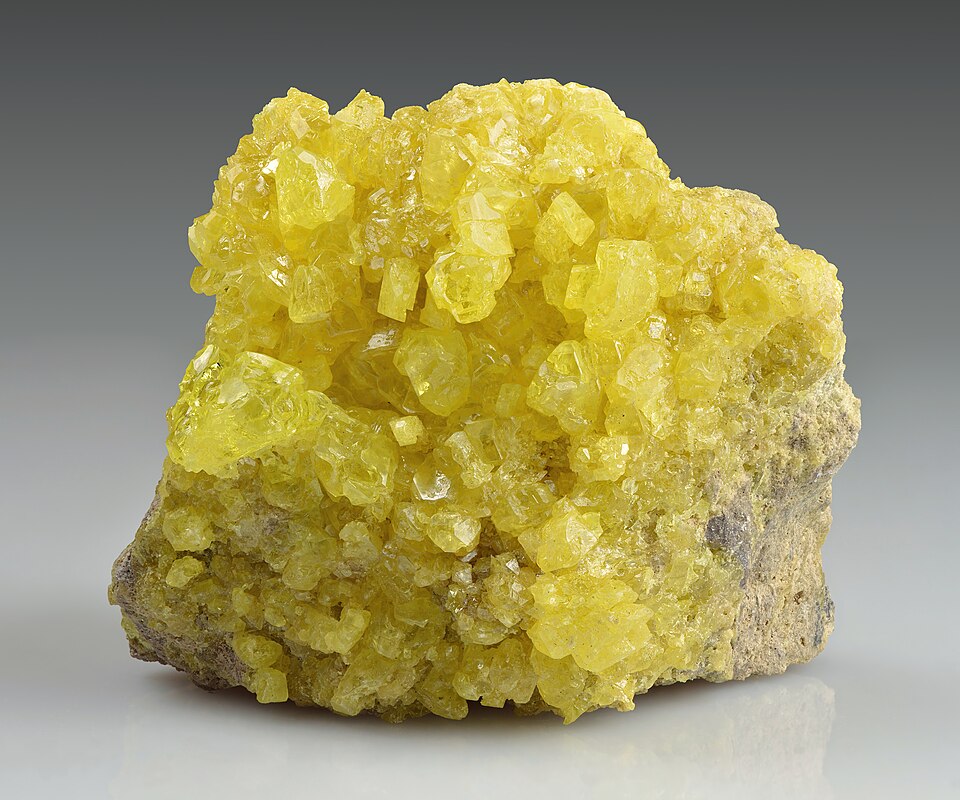
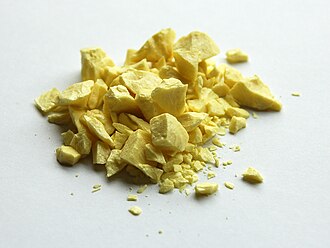
Sulfur is a native element famous for its bright yellow color. It forms blocky to dipyramidal crystals and earthy crusts around volcanic vents, hot springs, and salt domes, and has a distinctive resinous luster.
Also known as: Sulphur, Brimstone, Native sulfur.
Sulfur properties at a glance
| Type | Native Elements |
|---|---|
| Chemical formula | S |
| Mohs hardness | 2 |
| Crystal system | orthorhombic |
| Luster | resinous |
| Streak | White to pale yellow |
| Cleavage | Imperfect |
| Fracture | Conchoidal to uneven |
| Specific gravity | 2.07 |
| Transparency | transparent |
| Common colors | Yellow, Bright yellow, Yellowish brown, Greenish yellow |
| Rarity | common |
Geology & background
Native sulfur forms around volcanic vents and hot springs, in cap rock above salt domes, and through the alteration of sulfide minerals and sulfate-bearing sediments.
Sulfur has been used for thousands of years in medicine, fumigation, gunpowder, and bleaching, and it remains a foundational raw material for sulfuric acid and modern chemical industry.
How to identify Sulfur
- Look for bright yellow color, resinous luster, and very low hardness near 2 that a knife scratches easily.
- Low density and a faint sulfur odor when freshly broken or warmed are strong clues.
- Occurrence near volcanic vents, hot springs, or salt domes supports the identification.
Full Sulfur identification guide: checklist, home tests and look-alikes →
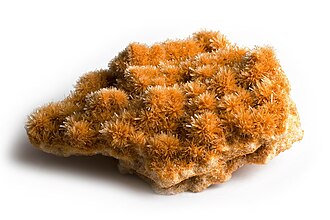
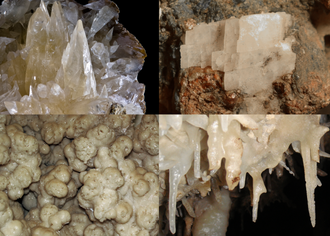
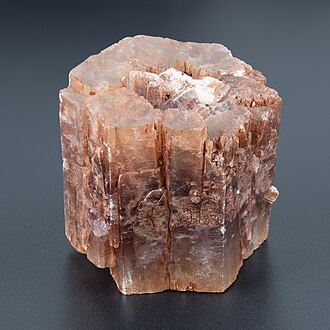
Sulfur photos
Sulfur vs similar stones
Not sure it isn't something else? Side-by-side comparisons with the stones most often confused with Sulfur.
Where Sulfur is found
Native sulfur occurs around volcanic vents, hot springs, and salt domes, with notable specimen localities in Italy, the United States, Bolivia, Indonesia, Poland, and Japan.
How much is Sulfur worth?
| Entry-level specimen | $5 |
|---|---|
| Typical collector specimen | $35 |
| Premium specimen | $250+ |
Value depends on crystal size, color, transparency, intactness, matrix, and locality.
Common uses
- Production of sulfuric acid
- Fertilizers and agricultural chemicals
- Vulcanizing rubber
- Collector specimens
Interesting facts
- Sulfur was historically known as brimstone and has been used since ancient times.
- It is a poor conductor of heat, and a warm hand can crackle a sulfur crystal as the surface expands.
- Burning sulfur produces a sharp, pungent odor of sulfur dioxide.
- Most industrial sulfur today is recovered from oil and natural gas rather than mined as the native element.
Care & safety
Sulfur is soft, brittle, and sensitive to temperature change, so crystals crack and chip easily.
Flammable material. Sulfur is flammable and burns with toxic sulfur dioxide fumes; keep it away from flame and heat.
Avoid inhaling dust. Do not cut, grind, or polish specimens without eye protection and a proper respirator.
Sulfur FAQ
What is Sulfur?
Sulfur is a native element famous for its bright yellow color. It forms blocky to dipyramidal crystals and earthy crusts around volcanic vents, hot springs, and salt domes, and has a distinctive resinous luster.
How much is Sulfur worth?
Entry-level Sulfur specimens sell for around $5, a typical collector specimen for about $35, and premium pieces for $250 or more. Value depends on crystal size, color, transparency, intactness, matrix, and locality.
How hard is Sulfur?
Sulfur has a Mohs hardness of 2. A fingernail (Mohs 2.5) scratches it easily.
Where is Sulfur found?
Notable sources of Sulfur include Italy, United States, Bolivia, Indonesia, Poland, and Japan. Native sulfur forms around volcanic vents and hot springs, in cap rock above salt domes, and through the alteration of sulfide minerals and sulfate-bearing sediments..
What is Sulfur used for?
Sulfur is used for production of sulfuric acid, fertilizers and agricultural chemicals, vulcanizing rubber, and collector specimens.