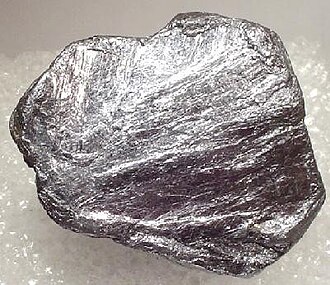
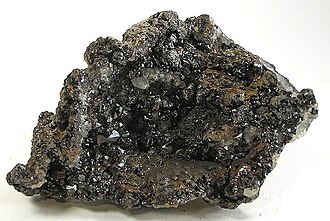
Sulfide Minerals · uncommon
Realgar
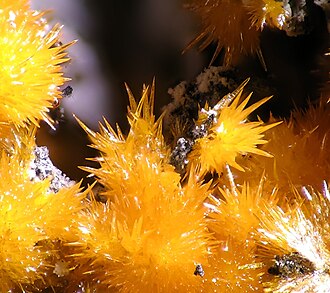
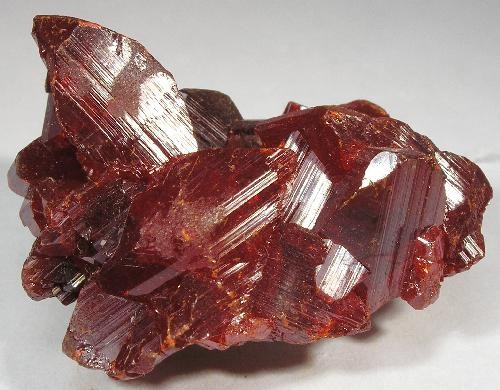
Realgar is an arsenic sulfide mineral famous for its brilliant orange-red to red color and resinous luster. It forms soft, often translucent crystals and granular crusts, and slowly breaks down to a powder when exposed to light.
Also known as: Arsenic blende, Ruby sulphur.
Realgar properties at a glance
| Type | Sulfide Minerals |
|---|---|
| Chemical formula | As4S4 |
| Mohs hardness | 1.75 |
| Crystal system | monoclinic |
| Luster | resinous |
| Streak | Orange-red to yellow-orange |
| Cleavage | Good |
| Fracture | Conchoidal |
| Specific gravity | 3.56 |
| Transparency | translucent |
| Common colors | Red, Orange-red, Orange |
| Rarity | uncommon |
Geology & background
Realgar forms in low-temperature hydrothermal veins, around hot springs and volcanic vents, and as a deposit associated with other arsenic and antimony minerals.
Realgar was used for centuries as a red-orange pigment in painting and as a source of arsenic for pyrotechnics, pest control, and early medicine, despite its serious toxicity.
How to identify Realgar
- Look for a brilliant orange-red to red color, resinous luster, and an orange-red streak.
- Realgar is very soft and translucent, and old specimens may show a dusty yellow alteration crust.
- It commonly occurs with yellow orpiment in low-temperature veins, which helps confirm identification.
Full Realgar identification guide: checklist, home tests and look-alikes →
Realgar vs similar stones
Not sure it isn't something else? Side-by-side comparisons with the stones most often confused with Realgar.
Where Realgar is found
Realgar occurs in low-temperature hydrothermal veins and hot-spring deposits worldwide, with notable specimen localities in China, Romania, the United States, Peru, Switzerland, and Germany.
How much is Realgar worth?
| Entry-level specimen | $10 |
|---|---|
| Typical collector specimen | $70 |
| Premium specimen | $450+ |
Value depends on color, crystal size and form, condition, locality, matrix, and degree of light damage.
Common uses
- Historical red pigment
- Arsenic source
- Pyrotechnics
- Collector specimens
- Educational mineral examples
Interesting facts
- Realgar slowly disintegrates into a yellow-orange powder when exposed to light over time.
- Its name comes from an Arabic phrase meaning powder of the mine.
- Realgar was used historically as a vivid red-orange pigment despite its toxicity.
- It commonly occurs alongside the yellow arsenic sulfide orpiment, into which it can alter.
Care & safety
Realgar is very soft and fragile and slowly breaks down to powder when exposed to light.
Toxic arsenic mineral. Realgar contains arsenic; do not lick, ingest, or inhale dust, wash hands after handling, and never cut or grind it.
Store away from light. Light exposure degrades realgar into a fine powder, so keep specimens in dark, enclosed storage.
Realgar FAQ
What is Realgar?
Realgar is an arsenic sulfide mineral famous for its brilliant orange-red to red color and resinous luster. It forms soft, often translucent crystals and granular crusts, and slowly breaks down to a powder when exposed to light.
How much is Realgar worth?
Entry-level Realgar specimens sell for around $10, a typical collector specimen for about $70, and premium pieces for $450 or more. Value depends on color, crystal size and form, condition, locality, matrix, and degree of light damage.
How hard is Realgar?
Realgar has a Mohs hardness of 1.75. A fingernail (Mohs 2.5) scratches it easily.
Where is Realgar found?
Notable sources of Realgar include China, Romania, United States, Peru, Switzerland, and Germany. Realgar forms in low-temperature hydrothermal veins, around hot springs and volcanic vents, and as a deposit associated with other arsenic and antimony minerals..
What is Realgar used for?
Realgar is used for historical red pigment, arsenic source, pyrotechnics, collector specimens, and educational mineral examples.