Phosphate Minerals · uncommon
Vivianite
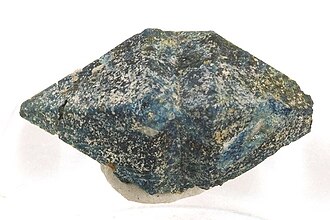
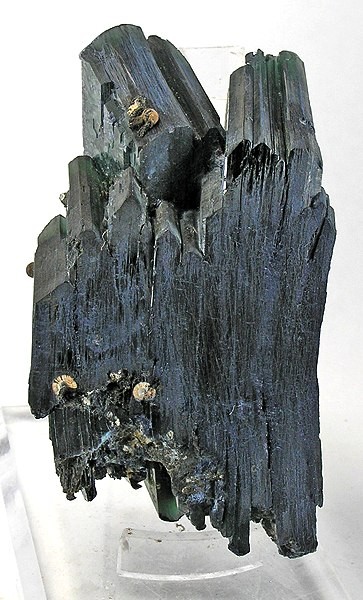
Vivianite is a hydrated iron phosphate that is colorless when fresh but oxidizes to deep blue and green. It forms bladed, prismatic, or fibrous crystals and earthy masses, and is a favorite of collectors for its rich color.
Also known as: Iron phosphate, Blue iron earth.
Vivianite properties at a glance
| Type | Phosphate Minerals |
|---|---|
| Chemical formula | Fe3(PO4)2·8H2O |
| Mohs hardness | 1.75 |
| Crystal system | monoclinic |
| Luster | vitreous |
| Streak | Bluish white |
| Cleavage | Perfect |
| Fracture | Fibrous |
| Specific gravity | 2.68 |
| Transparency | translucent |
| Common colors | Blue, Green, Colorless |
| Rarity | uncommon |
Geology & background
Vivianite forms as a secondary mineral in iron-rich, phosphate-bearing environments, including the oxidation zones of ore deposits, clay sediments, peat bogs, and even buried organic remains.
Vivianite was named in 1817 after the English mineralogist John Henry Vivian. It has long interested collectors and has been noted by archaeologists for forming on buried bone and metal.
How to identify Vivianite
- Look for deep blue to green bladed or prismatic crystals with a perfect cleavage.
- Extreme softness, easily scratched by a fingernail, helps distinguish vivianite.
- Darkening of color on exposure to light supports identification.
Full Vivianite identification guide: checklist, home tests and look-alikes →
Vivianite vs similar stones
Not sure it isn't something else? Side-by-side comparisons with the stones most often confused with Vivianite.
Where Vivianite is found
Vivianite occurs in iron-rich phosphate environments worldwide, with notable crystal localities in Bolivia and additional finds in the United States, Cameroon, Brazil, Australia, and Ukraine.
How much is Vivianite worth?
| Entry-level specimen | $10 |
|---|---|
| Typical collector specimen | $60 |
| Premium specimen | $400+ |
Value depends on crystal size, color, transparency, locality, damage, and overall aesthetics.
Common uses
- Collector specimens
- Historic blue pigment
- Educational mineralogy
- Mineralogical research
Interesting facts
- Fresh vivianite is nearly colorless but darkens to deep blue or green as it oxidizes in light and air.
- Vivianite has been found encrusting fossil bones, shells, and even archaeological artifacts.
- It has historically been used as a blue pigment sometimes called blue iron earth.
- Vivianite is extremely soft, easily marked by a fingernail.
Care & safety
Vivianite is extremely soft and brittle with perfect cleavage, so crystals damage very easily.
Avoid inhaling dust. Do not cut, grind, or polish unknown specimens without eye protection and a proper respirator.
Light sensitive and fragile. Vivianite is very soft and darkens in light; store it shielded from bright light and handle it minimally.
Vivianite FAQ
What is Vivianite?
Vivianite is a hydrated iron phosphate that is colorless when fresh but oxidizes to deep blue and green. It forms bladed, prismatic, or fibrous crystals and earthy masses, and is a favorite of collectors for its rich color.
How much is Vivianite worth?
Entry-level Vivianite specimens sell for around $10, a typical collector specimen for about $60, and premium pieces for $400 or more. Value depends on crystal size, color, transparency, locality, damage, and overall aesthetics.
How hard is Vivianite?
Vivianite has a Mohs hardness of 1.75. A fingernail (Mohs 2.5) scratches it easily.
Where is Vivianite found?
Notable sources of Vivianite include Bolivia, United States, Cameroon, Brazil, Australia, and Ukraine. Vivianite forms as a secondary mineral in iron-rich, phosphate-bearing environments, including the oxidation zones of ore deposits, clay sediments, peat bogs, and even buried organic remains..
What is Vivianite used for?
Vivianite is used for collector specimens, historic blue pigment, educational mineralogy, and mineralogical research.