Phosphate Minerals · uncommon
Wavellite
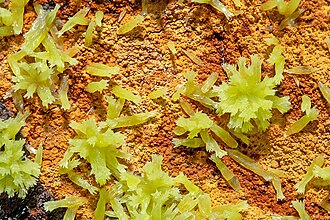
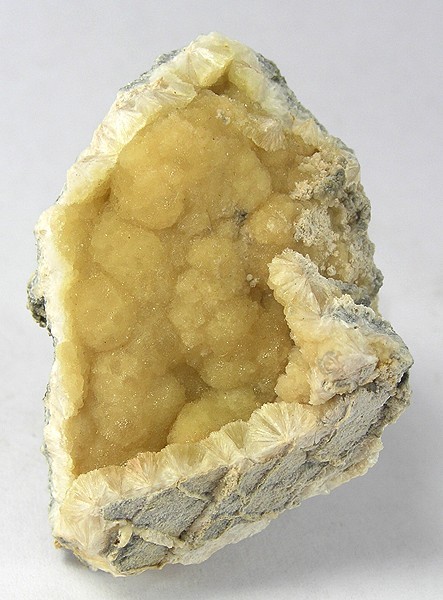
Wavellite is a hydrated aluminum phosphate famous for its radiating, spherical crystal aggregates. When a specimen is broken, the fan-like internal structure forms a distinctive starburst pattern that makes wavellite a collector favorite.
Also known as: Aluminum phosphate.
Wavellite properties at a glance
| Type | Phosphate Minerals |
|---|---|
| Chemical formula | Al3(PO4)2(OH,F)3·5H2O |
| Mohs hardness | 3.75 |
| Crystal system | orthorhombic |
| Luster | vitreous |
| Streak | White |
| Cleavage | Perfect |
| Fracture | Uneven |
| Specific gravity | 2.36 |
| Transparency | translucent |
| Common colors | Green, Yellow, White, Brown |
| Rarity | uncommon |
Geology & background
Wavellite is a secondary mineral that forms when phosphate-rich solutions react with aluminous rocks, depositing radiating crystal aggregates in fractures and cavities of low-grade metamorphic and sedimentary rocks.
Wavellite was named in 1805 in honor of William Wavell, who brought it to mineralogists' attention. It has remained a well-known collector mineral valued for its unmistakable radiating habit.
How to identify Wavellite
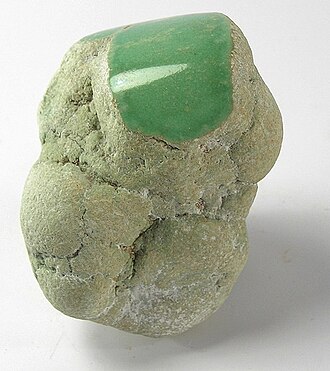
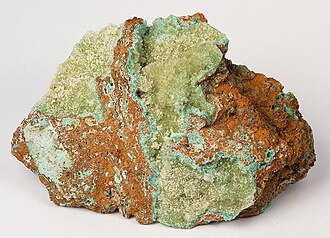
- Look for green to yellow spherical or botryoidal aggregates with a radiating internal structure.
- A broken surface showing a fan-like starburst pattern is nearly diagnostic of wavellite.
- Moderate hardness near 3.75 and occurrence on fracture surfaces support identification.
Full Wavellite identification guide: checklist, home tests and look-alikes →
Wavellite vs similar stones
Not sure it isn't something else? Side-by-side comparisons with the stones most often confused with Wavellite.
Where Wavellite is found
Wavellite occurs as a secondary phosphate mineral, with classic radiating specimens from Arkansas in the United States and additional localities in the United Kingdom, Bolivia, Germany, Australia, and Brazil.
How much is Wavellite worth?
| Entry-level specimen | $8 |
|---|---|
| Typical collector specimen | $45 |
| Premium specimen | $250+ |
Value depends on color, quality of the radiating pattern, size, locality, damage, and overall aesthetics.
Common uses
- Collector specimens
- Educational mineralogy
- Display and decorative pieces
- Mineralogical research
Interesting facts
- Broken wavellite spheres reveal a striking radiating, starburst internal structure.
- It is named after the English physician and mineral collector William Wavell.
- Wavellite most often shows green and yellow color zoning within its radiating balls.
- Arkansas in the United States is a classic source of fine wavellite specimens.
Care & safety
Wavellite is moderately soft with perfect cleavage, and its radiating crystals can break easily.
Avoid inhaling dust. Do not cut, grind, or polish unknown specimens without eye protection and a proper respirator.
Wavellite FAQ
What is Wavellite?
Wavellite is a hydrated aluminum phosphate famous for its radiating, spherical crystal aggregates. When a specimen is broken, the fan-like internal structure forms a distinctive starburst pattern that makes wavellite a collector favorite.
How much is Wavellite worth?
Entry-level Wavellite specimens sell for around $8, a typical collector specimen for about $45, and premium pieces for $250 or more. Value depends on color, quality of the radiating pattern, size, locality, damage, and overall aesthetics.
How hard is Wavellite?
Wavellite has a Mohs hardness of 3.75. A steel knife blade (Mohs 5.5) scratches it; a copper coin does not.
Where is Wavellite found?
Notable sources of Wavellite include United States, United Kingdom, Bolivia, Germany, Australia, and Brazil. Wavellite is a secondary mineral that forms when phosphate-rich solutions react with aluminous rocks, depositing radiating crystal aggregates in fractures and cavities of low-grade metamorphic and sedimentary rocks..
What is Wavellite used for?
Wavellite is used for collector specimens, educational mineralogy, display and decorative pieces, and mineralogical research.